Disclosure: This article contains affiliate links. If you buy through them, I may earn a small commission at no extra cost to you.
Table of Contents
Just like a good taxi needs the right parts for a long journey across the Atlas Mountains, a good tajine needs the right tools. As an Amazon Associate, I earn from qualifying purchases when you use my trusted links below, which helps keep this blog running at no extra cost to you.
Moroccan couscous. It is not just food. It is the heartbeat of Friday.
In my country, even the air feels different on Fridays. I remember driving my taxi through the streets of Rabat. Windows rolled down. Just after noon, you notice two things. First, a heavy, peaceful silence. Men gathering in the mosques for the Jumu’ah prayer.
And second? The smell.
Oh, that smell.
It drifts from the open windows of the rich and the poor alike. The rich scent of steamed semolina. Sweet pumpkin melting into a golden broth.
You see, Friday is not just for prayer. It is the day of the traditional Moroccan couscous. The unwritten law of our land.

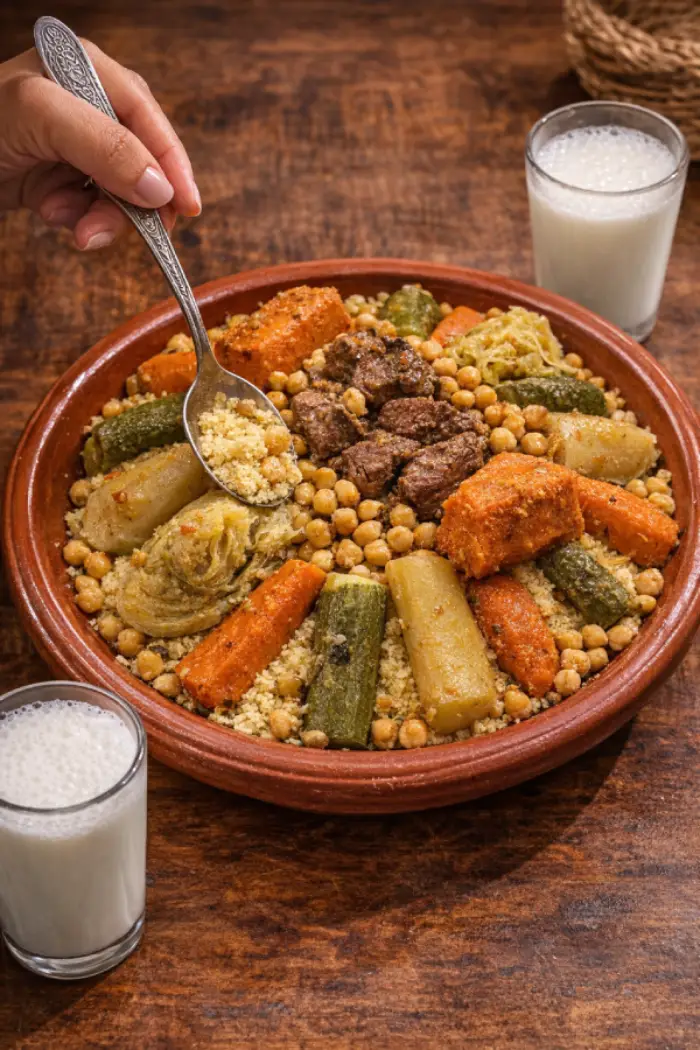
When the prayer ends, we don’t rush out to restaurants with separate tables. No. We go home. We gather around a low, round table. Shoulder to shoulder. Knees touching. In the center, there is no fine china. There is only the Gassaa.
The Gassaa is a heavy, wide platter made of terracotta. Our own earth. It keeps the food warm, yes. But mostly, it makes the Moroccan couscous taste like the soul of the country.
We all eat from this one dish. Hand to mouth. It reminds us. Whether you are a king in a palace, or an old taxi driver with calloused hands like me… on Fridays, we are exactly the same. We share the same spoon. The same blessing. The same authentic Moroccan couscous.
The Soul of an Authentic Moroccan Couscous Recipe
Far from home, I see them in the supermarket aisles.. Little cardboard boxes. “Ready in five minutes,” the label says.
I just shake my head. I wipe my hands on my apron.
That is not an authentic Moroccan couscous recipe. That is just boiling water and sad grain. You cannot rush a Friday. Real cooking takes time. It takes your bare hands. It takes the hot steam rising up, making your cheeks wet while the beef and chickpeas roll in the heavy broth below.
To make the true Friday feast, you do not need a factory. You need the touch of the artisan. The little things. The secrets a mother whispers over a hot clay pot.
If you want your Moroccan couscous recipe to taste like the old medina, you must remember three things:
- The Marriage of Oils. Do not use only olive oil. It is too heavy for the high heat. It burns and loses its song. We mix them. Half extra virgin olive oil for the deep, earthy soul. Half vegetable oil for the frying. Together, they brown the meat perfectly.
- The Late Tomato. Many people throw all the vegetables into the water at the beginning. No. The hard carrots and turnips go first. But the tomato? You grate it fresh. You hold it back in a bowl. You add it late, right when the soft pumpkin goes in. Why? Because we do not want a thin, watery soup. The late tomato thickens the broth. It turns it into a rich, golden velvet that hugs the grain.
- The First and Last Touch: Smen. Ah, smen. Aged, salted Moroccan butter. It has a smell you never forget. A deep, fermented funk. We add one spoonful at the very beginning, to wake the meat up in the hot oil. And one final spoonful, rubbed directly into the hot, steamed couscous just before serving.
It is the alpha and the omega of the pot. If you cannot find smen, use good ghee. But the smen… it is the fingerprint of our culture.
These are not just steps. They are respects paid to the food. It is how we build the soul of an authentic Moroccan couscous.
The Market Basket (Gathering Our Ingredients)
Come with me. Leave the supermarket behind. Grab a woven basket.
Today, we go to the souk. The old market. It is loud. The carts rattle on the stones. But this is where a real Moroccan couscous begins. We don’t read barcodes here. We use our eyes. We touch the skin of the vegetables. We smell the dirt still clinging to the roots.
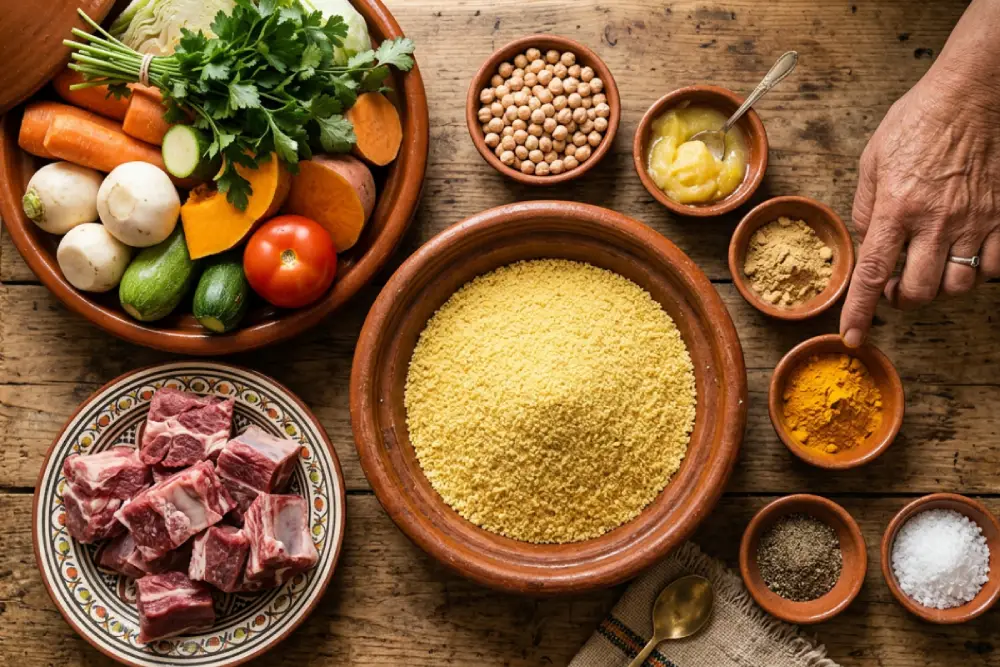
The Heart: Beef, Spices, and Smen
We stop at the butcher first. He is wiping his heavy knife. He knows my face. He knows what I need for a Friday Moroccan couscous recipe. I point to the hanging meat.
- 1.5 to 2 lbs beef chunks. Do not buy the lean, sad pieces. Get it with the bone. The bone is everything. The marrow melts and gives the broth its sticky, rich lips.
- 1 cup dried chickpeas. You must soak them in water overnight. Never from a tin. A tin has no memory.
- 1 large onion. Chopped rough, into big squares.
- ½ cup mixed oil. Half olive, half vegetable.
- The Spices. The dust of our ancestors: 1 tbsp salt, 1 tbsp ginger powder, 1 tbsp yellow turmeric, 1 tsp black pepper.
- 1 tbsp Smen. Or ghee, if you are far from home.
- A fresh herb bouquet. Tie parsley and cilantro together with a string. Put it to your nose. Smell it. Earth and rain.
The Seven Vegetables
We walk deeper into the market. The vegetable stalls. The colors hit your eyes. A traditional Moroccan couscous must have seven vegetables. Seven is a lucky number. A blessed number. But they do not cook the same way. We must separate them.
First, we buy the hard roots. The fighters. They will go in the pot early to drink the boiling water.
Then, we pick the soft ones. The ones that melt and surrender.
- 1 lb Red Pumpkin. Or butternut squash. Huge chunks.
- 3-4 Zucchini. Sliced long.
- 1 Sweet Potato. This is optional. But it is my favorite secret. It adds a whisper of sugar against the salt.
- 1 cup fresh grated tomato. Our secret thickener.
- 1 whole hot chili pepper. Green or red. Do not cut it! We just want its perfume, not its fire.
The Grain
Finally, we find the man sitting behind the large canvas sacks. I plunge my bare hands into the cool, dry grains. They run through my fingers like yellow sand.
- 2 lbs medium-grain Moroccan couscous. Not the fine dust. And please, not the instant box. The real, medium grit.
- Water. Plenty of it, for sprinkling and waking up the dry grain.
- 2 tbsp vegetable oil. To coat the raw grains so they do not fight and stick together.
- Salt. To taste.
- 1 tbsp Smen. For the very end. The final blessing.
My basket is heavy now. The straps dig into my shoulder. Good. Let us go back to the kitchen, roll up our sleeves, and start our Moroccan couscous.
How to Cook the Friday Feast (Step-by-Step)
Tie your apron. Wash your hands. Stand next to me at the stove.
We do not rush this. A true Moroccan couscous recipe is a test of patience. We do not read a manual. We cook by feeling. By listening to the heavy iron pot.
Step 1: Waking Up the Aromas
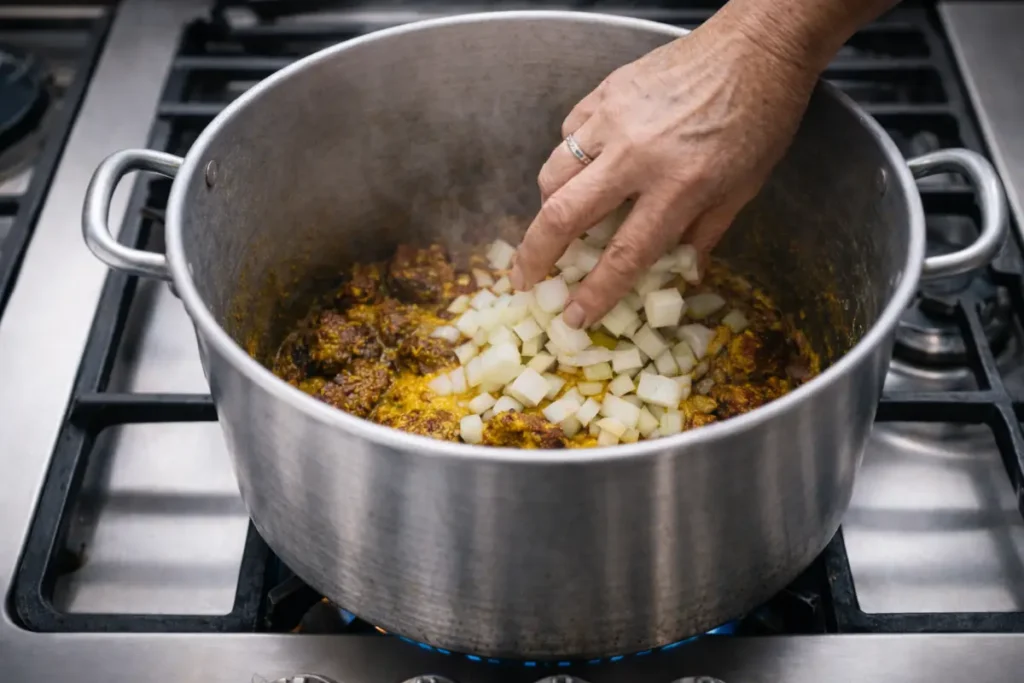
Take the bottom of your Couscousier—the big steamer pot. Put the fire on high. Pour in our oil blend. Now, drop in the roughly chopped onion, the bone-in beef, and that first thick spoonful of smen.
Listen to it. It sizzles. The funky, rich smell hits the ceiling immediately.
Throw in the spices. The turmeric, ginger, black pepper, and salt. Stir it hard with a long wooden spoon. Watch the meat put on a golden, yellow coat. Add your soaked chickpeas. Now, pour in boiling water until the meat is submerged. Drop the tied parsley and cilantro right into the deep bath. Cover it with the lid. Let the water rumble and roll for 15 minutes.
Step 2: The Hard Roots & The First Steam
The broth is boiling hot. Time for the fighters. Drop in the hard roots—the carrots, turnips, and the thick cabbage wedges. They need time to surrender.
Now, turn your back to the stove. Look at your dry Moroccan couscous. Pour it into your wide bowl. Drizzle two tablespoons of oil over it. Plunge your bare hands in. Rub the grains gently between your palms. Make every single little grain shine. Splash a cup of cold water over it. Mix it. Step away. Let it sit in the water for 10 minutes.
Lift the damp grain into the top steamer basket. Set it directly over the boiling meat pot.
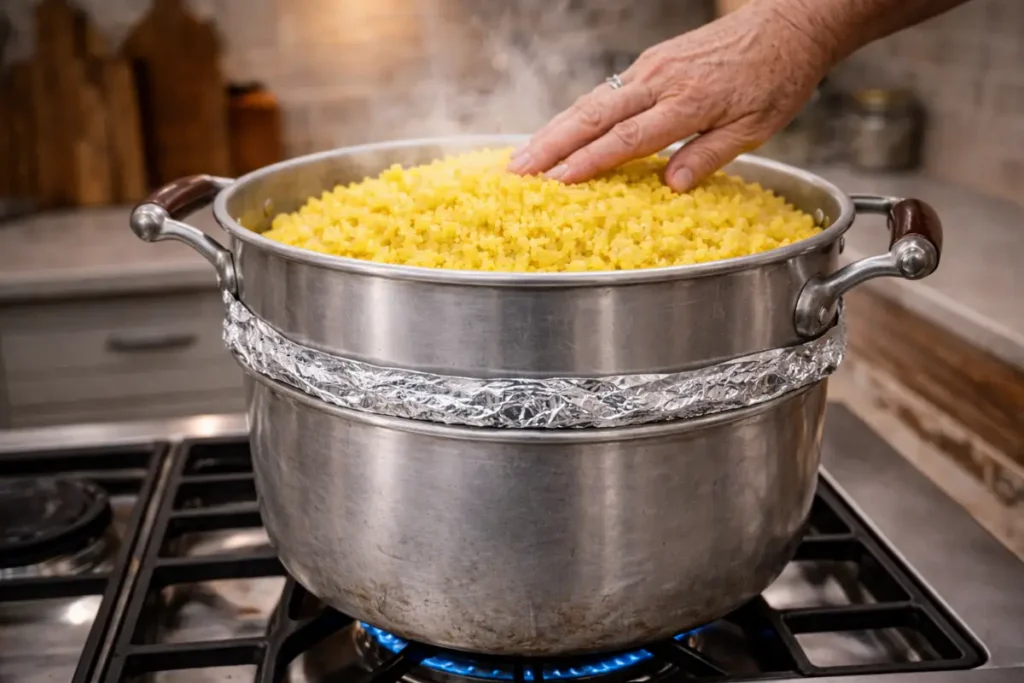
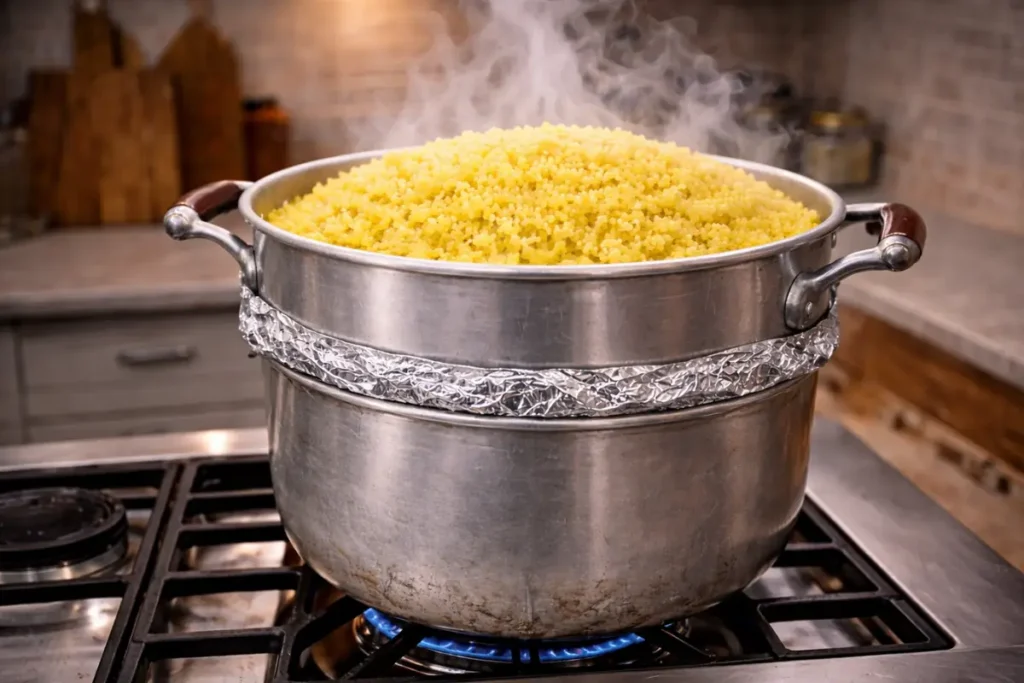
If steam escapes from the crack between the two pots, seal it with a strip of aluminum foil. We must trap the heat.
Wait. Watch the top. When you see the white ghost of steam pushing up clearly through the yellow grains… let it steam for 15 to 20 minutes.
Step 3: The Soft Veggies & The Secret Tomato Broth
Take the top basket off. Dump the hot, steaming grain back into your wide bowl.
Yes, it burns your fingers a little. It is the kiss of the kitchen. You get used to it. Splash the hot grain with a cup or two of cold water and a good pinch of salt. Break the hot clumps with your hands. Fluff it open. Let it sit and breathe for 15 minutes. It will swell up.
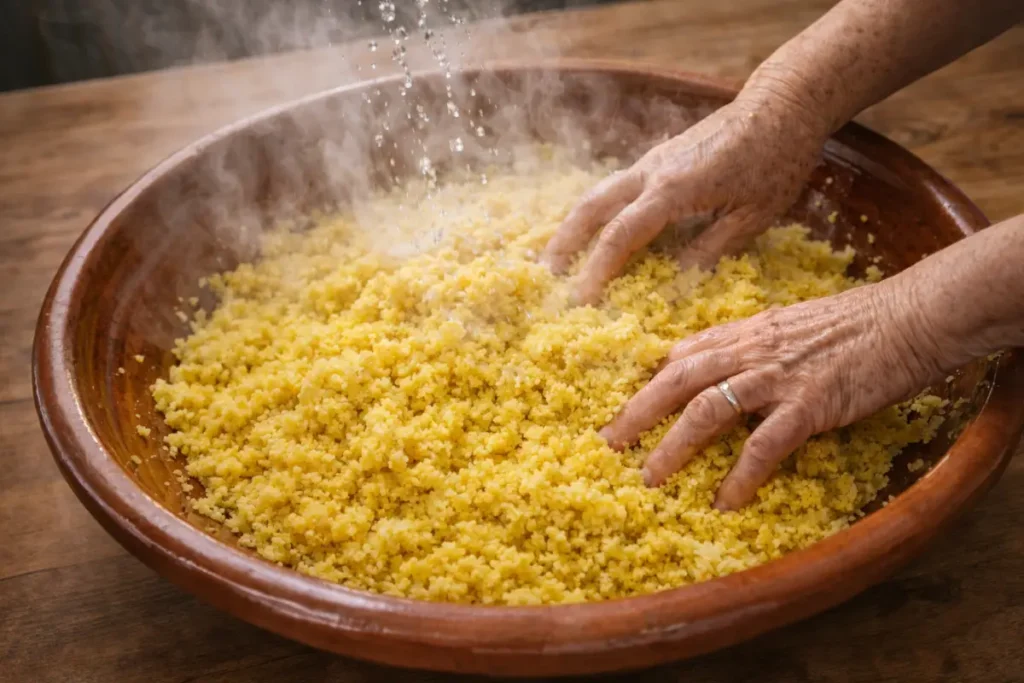
While it rests, look at your boiling broth. It is time. Slide in the soft ones. The sweet pumpkin chunks. The zucchini. The sweet potato. Drop the whole hot chili pepper on top. Do not break it, or the broth will catch fire.
Now… the artisan’s secret. Pour in that bowl of fresh, grated tomato. Stir gently. Watch the thin soup turn heavy. Watch it become a rich, red velvet.
Step 4: The Final Fluff
The grain is rested now. Plump and heavy.
Lift it back into the steamer basket. Set it over the thick, bubbling tomato broth one last time. Let the steam rise through it again for 20 more minutes. The steam carries the memory of the meat, the sweet pumpkin, and the spices right up into the heart of the couscous.
When you take it off the fire, the grains are soft like clouds. They do not stick. They fall apart in your hands. Perfect.
The Ritual of the Gassaa (How to Serve)
The fire is off. The kitchen is quiet, but heavy with steam. My apron smells like saffron and wet earth.
This is the moment. The reward for your burnt fingers and tired feet. A Moroccan couscous recipe is never finished in the pot. It is finished on the table. We do not just put food on plates. We build a mountain.
Bring out your Gassaa. If you do not have one, a wide, shallow platter will do.
Pour the hot, steaming grains into the center. They tumble out like golden sand. Take that last, beautiful spoonful of smen. Drop it right into the middle of the heat. Use your wooden spoon, or your bare hands if you are brave. Rub the melting butter into every grain. Watch it disappear. Watch the couscous take on a shine that catches the light from the window.
Now, shape it. Smooth the edges with your palms. Make a perfect dome.
Take your spoon and dig a deep crater right in the top center of the mountain. Like a volcano waiting to erupt.
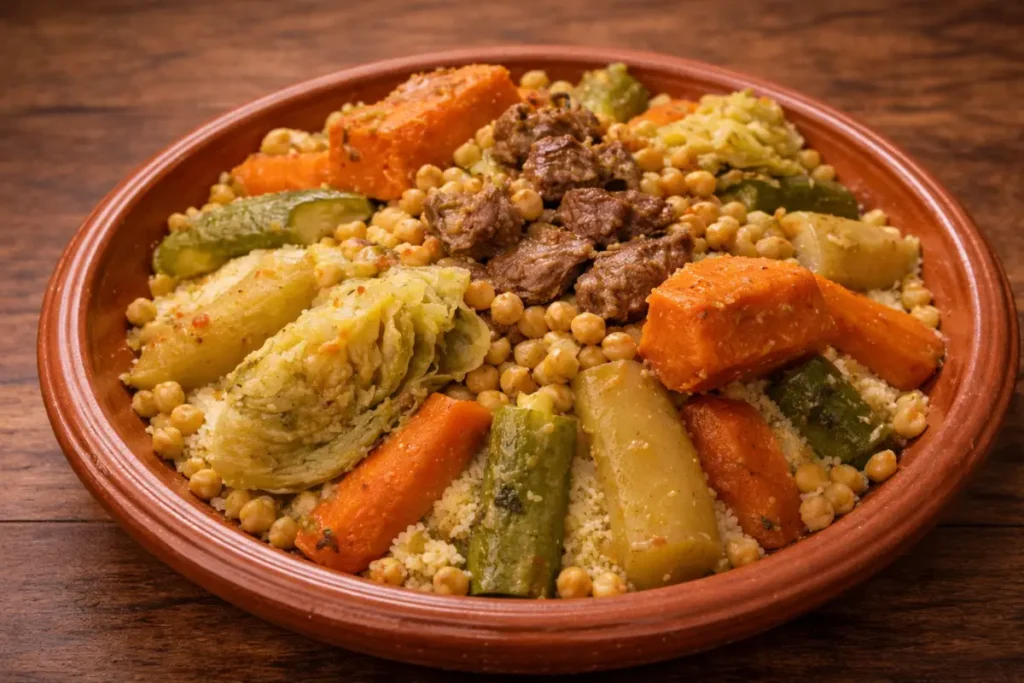
Lift the heavy, tender beef chunks from the bottom of the pot. Place them gently into the crater. They are so soft they almost break. Surround the meat with the sweet, melting chickpeas.
Then comes the crown. We don’t just dump the vegetables. We place them. A long carrot here. A wedge of soft, bright pumpkin there. The pale turnips. The sweet potato. The green zucchini. We arrange them in a circle around the meat, running down the sides of the mountain. Place the whole, unbroken chili pepper right at the peak, standing guard.
Now… the soul of the dish.
Take a ladle. Dip it into the thick, red-gold broth at the bottom of the pot. The tomato and the marrow have done their work. It is heavy. Rich. Pour it slowly over the mountain. Let it soak into the grains. The couscous drinks it up instantly. Do not drown it. Just make it wet and heavy.
Keep a small bowl of the extra broth on the table, for those who like it wet like the sea.
Wipe the edges of the Gassaa. Carry it to the low table. Put it down in the center. The steam rises up into the faces of your family sitting shoulder to shoulder.
Look at them. Look at the smiles.
Say Bismillah. In the name of God.
Eat.
Wisdom from the Road (The Artisan’s Tips)
The road from Rabat down to the south… it is long. Hot. Sometimes, a tire blows. You don’t sit and cry. You open the trunk. You fix it with what you have. Your hands get dirty.
Cooking a true Moroccan couscous is the same thing.
I hear you from across the ocean. Asking me from your clean, modern kitchens. “Chef Reda, I do not have a heavy clay Gassaa. I do not have the right steamer from the souk. I cannot find the aged butter in my store.”
Stop. Breathe. Do not worry. The soul of the Friday meal is not stuck in a copper pot. It is right there, in your bare hands. It is in the patience you give to the dry grain. The time you let the meat boil until the bone lets go. If you understand why we do things—why we hold the grated tomato back, why we steam twice so the grain swells heavy and soft—you can cook this anywhere.
Listen to an old man. Here is how you make it work when you are far from the medina.
FAQ: Your Authentic Moroccan Couscous Questions Answered
What if I don’t have a traditional Couscousier?
You don’t need a heavy copper pot from the old market. Open your cupboards. Find a big, deep pasta pot. Find a metal strainer that sits tight on top. Good. You just made a Couscousier.
But listen. Steam is lazy. It tries to escape from the sides. Don’t let it. Tear a long strip of aluminum foil. Crumple it thick. Wrap it hard around the waist of the pots, right where they meet. Trap the heat. Force that wet, hot breath to push straight up into the dry Moroccan couscous. Make it work for you.
Can I substitute the Smen in this recipe?
Ah, smen. The fermented, salty butter of my grandfather’s house. You won’t find it easily outside of Morocco. But do not use sweet, yellow baking butter. It is too weak. It melts and dies in the broth.
Do I have to use bone-in beef?
You are the boss of your fire. But let me tell you the truth. A real Moroccan couscous recipe lives or dies by the broth. Lean, clean, boneless meat makes a sad, thin water.
You need the bone. The marrow inside. It melts down into the oil and the grated tomato. It makes the liquid heavy. Sticky. Rich enough to coat a wooden spoon. If you only have soft beef, go ask your butcher for cheap soup bones. Throw them in. Your Friday table needs that flavor.
The Final Drop (The Friday Sleep)
The Gassaa is almost empty now. Just a yellow stain of broth and a few stray chickpeas left at the bottom.
But wait. The ritual is not finished. I almost forgot to tell you.
Look at the table. There is no sweet mint tea here. Not today. With a heavy, authentic Moroccan couscous, we do not drink tea. We drink milk. But not the sweet milk from a carton. Fermented milk. We call it Lben.
Wherever you live, go find real, thick buttermilk. Pour it ice cold into small glasses. Drink it while your mouth is still hot from the chilli pepper and the steaming grain. The sharp, sour bite of the cold milk cuts right through the rich, heavy fat of the smen and the beef marrow. It cleans your tongue.
And then? Then comes the peace.
The heavy, beautiful sleep of a Friday afternoon. A full belly. A quiet house.
Try it this way. Just once. Gather your people. Steam the grain until it swells. Pour the cold Lben. Eat from one dish. Feel the blessing of the food you made with your own bare hands.
Besseha. To your health.
A Quick Look at the Friday Magic
Before you tie your apron, here is a very short video showing you the heart of the process. In just under a minute, you can see how we wake up the meat, handle the vegetables, and build the mountain. It is a quick summary of the journey, just to show you what your hands will be doing today. Watch it, then let’s start cooking.
My Trusted Kitchen Tools (What You Need for This Recipe)
Many of you ask me how to get the exact flavors of a Moroccan Friday in an American kitchen. Here are the specific tools and ingredients I trust on my own stove. (As an Amazon Associate, I earn from qualifying purchases.)
1. The Stainless Steel Couscoussier
If you do not have a traditional copper pot passed down from your mother, you must use the right alternative. I highly recommend a heavy-bottomed 12-quart stainless steel steamer pot (paid link) like this one. It acts exactly like our Moroccan couscoussier. The large bottom pot gives the seven vegetables enough room to boil without crowding the meat, while the tight-fitting top basket forces the steam straight up into the semolina to make it fluffy, not wet.
2. The Golden Secret: Authentic Smen (Or High-Quality Ghee)
In my country, smen (aged, salted butter) is the fingerprint of our cuisine. I know it is difficult to find outside of Morocco. Please, do not use regular sweet baking butter—it will melt and disappear into the broth. Instead, I strongly recommend using a rich, high-quality grass-fed ghee (paid link) like this one. You add one spoonful to wake up the meat in the hot oil, and one final spoonful rubbed directly into the steamed couscous just before serving. It holds that same deep, roasted memory we look for on a Friday.
3. The Heart of the Meal: Medium-Grit Couscous
I see them in the supermarkets—little boxes that say “ready in five minutes.” That is not an authentic Moroccan couscous. You cannot rush a Friday. You need dry, raw grains that can handle being steamed twice over a hot broth. I always use a true medium-grain authentic Moroccan couscous (paid link). It has the perfect strength to absorb the rich tomato and beef marrow broth, swelling up fluffy and soft like clouds without turning into mush.
4. The Gassaa: A Large Serving Platter
A Moroccan couscous is never finished in the pot; it is finished on the table. We do not serve this blessing on separate plates. We gather around one single, beautiful dish. Traditionally, we use a heavy clay Gassaa or a beautiful painted Taous plate. If you do not have one, you need a large, wide ceramic serving platter (paid link)—something flat and wide with low edges, not a deep salad bowl. It must be wide enough to build your mountain of semolina, dig a crater for the tender beef, and arrange the seven vegetables like a crown on top.
The Best Moroccan Couscous Recipe You’ve Ever Tasted

Equipment
- Traditional Couscousier (or a large deep pasta pot with a tight-fitting metal steamer basket)
- Aluminum foil (for sealing the steam)
- Gassaa (or a very large, wide wooden/clay bowl for fluffing the grain)
Ingredients
The Heart (Meat & Broth):
- 1.5 lbs bone-in beef chunks marrow bones give the best flavor
- 1 cup dried chickpeas soaked in water overnight
- 1 large onion roughly chopped into big squares
- 0.5 cup mixed oil half extra virgin olive oil, half vegetable oil
- 1 tbsp salt adjust to taste
- 1 tbsp ginger powder
- 1 tbsp yellow turmeric
- 1 tsp black pepper
- 1 tbsp smen aged Moroccan butter, or use ghee
- 1 fresh herb bouquet parsley and cilantro tied tightly with string
- Boiling water enough to fully submerge the meat
The Hard Roots (Added First):
- 3 carrots peeled and halved lengthwise
- 3 white turnips peeled and halved
- 0.5 head green cabbage cut into thick wedges
The Soft Vegetables (Added Later):
- 1 lb red pumpkin or butternut squash cut into large chunks
- 3 zucchini halved lengthwise
- 1 sweet potato optional, peeled and cut into chunks
- 1 cup fresh grated tomato the artisan’s secret to a thick broth
- 1 whole hot chili pepper do not cut or break it
The Grain:
- 2 lbs medium-grain Moroccan couscous dry, do not use instant
- 2 tbsp vegetable oil for coating the dry grains
- Water about 3-4 cups total, used in stages for wetting and fluffing
- 1 pinch salt
- 1 tbsp smen or ghee for the final fluff before serving
Instructions
Wake up the aromas:
- In the bottom of your Couscousier (steamer pot) over high heat, add the mixed oils, chopped onion, bone-in beef, and 1 tablespoon of smen. Let it sizzle and brown slightly.
Spice and boil:
- Stir in the salt, ginger, turmeric, and black pepper. Add the soaked chickpeas. Pour in enough boiling water to fully submerge the meat. Drop in the fresh herb bouquet. Cover and let it boil for 15 minutes.
Add the hard roots:
- Drop the carrots, turnips, and cabbage wedges into the boiling broth. These need time to surrender.
Prep the dry grain:
- In your large wide bowl, drizzle the dry couscous with 2 tablespoons of vegetable oil. Rub the grains gently between your bare hands so every grain shines. Splash with 1 cup of cold water, mix, and let it rest for 10 minutes to drink.
The first steam:
- Transfer the damp couscous to the top steamer basket. Place it over the boiling meat pot. (Wrap aluminum foil around the joint if steam escapes). Steam until you see white vapor rising clearly through the grains (about 15 to 20 minutes).
Fluff and rest:
- Remove the steamer basket. Dump the hot couscous back into your wide bowl. Splash with 1 to 2 cups of cold water and a good pinch of salt. Break the hot clumps with your hands or a wooden spoon. Let it sit and swell for 15 minutes.
Add the soft veggies and secret broth:
- Slide the pumpkin, zucchini, sweet potato, and the whole hot chili pepper into the boiling meat broth below. Pour in the 1 cup of fresh grated tomato to thicken the sauce into a rich velvet.
The second steam:
- Put the rested, plump couscous back into the steamer basket. Place it over the boiling pot one last time. Steam for another 20 minutes until the grains are soft like clouds.
The final blessing (Serving):
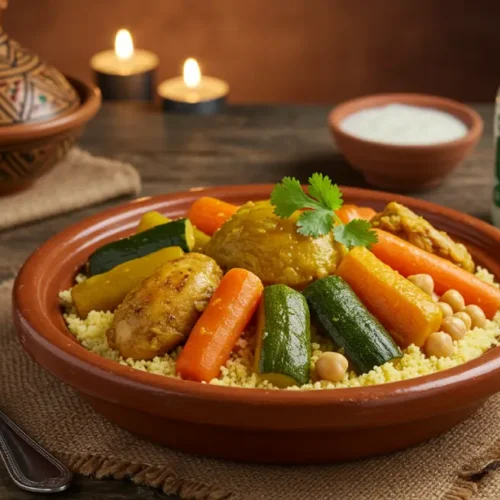
- Pour the finished couscous into your serving platter. Drop the final tablespoon of smen into the hot grains and rub it in. Shape the couscous into a dome, dig a crater in the center for the meat and chickpeas, arrange the vegetables around the sides, and pour the rich tomato broth over the top.
Notes
- No Couscousier? You don’t need a traditional copper pot. Use a large, deep pasta pot with a tight-fitting metal colander on top. Crumple a strip of aluminum foil and wrap it tightly where the two pots meet to trap the steam and force it upward.
- Smen Substitution: If you cannot find aged smen, do not use sweet baking butter (it will melt and disappear). Use high-quality Ghee from the Indian aisle. It holds that same deep, roasted memory.
- The Friday Drink: Do not serve this with sweet mint tea. Serve immediately with small glasses of ice-cold buttermilk (Lben). The sour bite cuts perfectly through the rich broth.
The Strength in the Bowl (Nutrition Information)
People ask me about numbers. Calories. Grams. I smile. In our kitchens, we do not measure the soul of the food with a calculator. But I know you need this. This is heavy, honest food. Fuel for a hard day’s work.
| Nutrient | Amount per Serving (Estimated for 1/8 of the Gassaa) |
| Calories | 550 kcal |
| Protein | 32 g |
| Carbohydrates | 68 g |
| Fat | 18 g |
| Dietary Fiber | 11 g |
| Sugars | 9 g (natural from the sweet pumpkin and roots) |
| Sodium | 650 mg |
A Note from the Artisan:
Listen to me. Every carrot grows differently in the earth. Every cut of bone-in beef holds its own rich fat. You might use a heavy hand with the smen, or a lighter splash of oil. These numbers are just a guide for your mind. We cook with feeling, not with scales. The real measure of this meal is the deep, peaceful sleep it brings you afterward.
Note: Nutritional values are approximate and may vary based on ingredient brands and portion sizes.
✉️ Pull Up a Chair (Join My Friday Table)
I have driven the roads of Morocco for twenty years. I have eaten in the high Atlas mountains and in the hidden alleys of the old medinas. The recipes I learned… you will not find them in any cookbook or supermarket.
They are the secrets whispered between mothers. The true taste of our earth.
Don’t lose the way back to my kitchen. Leave your email below, and once a week, I will send you one authentic, step-by-step Moroccan recipe directly to your inbox. No spam. Just real food, old stories, and a warm seat at my table.
🤝 Let Us See Your Gassaa! (Share Your Feast)
Did you tie your apron and cook this traditional Moroccan couscous for your family? I want to see the mountain you built with your own hands!
Take a picture of your steaming Gassaa before the spoons dig in.
- Tag me on Pinterest @TajineRecipes so I can pin your masterpiece to our community board.
- Share it with your friends using the buttons below, so they can learn the true taste of a Moroccan Friday.
Let’s keep the old ways alive together. Besseha!
💬 The Kitchen is Open (Leave a Question or Memory)
When you eat from the same Gassaa, you talk to each other. The same goes for this blog.
Did you try making this Friday couscous? Did you find the smen, or did you use ghee? Maybe you burned your fingers a little during the first steam? (It happens to the best of us!)
Leave a comment below. Ask me any question about the steps, the ingredients, or tell me how your family liked it. I read every single message, and the old taxi driver always answers.