Table of Contents
The Tagine Waiting at My Aunt’s House
I do not remember the exact year anymore.
When you spend decades behind the wheel of a grand taxi in Rabat, the years begin to run together. One road becomes another. One passenger steps out, another climbs in. Even the trees beside the highway start to look like part of the same long journey.
But some afternoons do not disappear.
This Beef Tagine Recipe begins with one of them.
It was May, right in the heart of spring. I had a full taxi that morning, carrying passengers from Rabat toward Imouzzer Kandar. The road had already taken nearly three hours from me by the time we arrived. I dropped everyone at the station, stretched my back, and looked toward the small streets beyond the parked taxis.
Imouzzer Kandar is a quiet town in Sefrou Province, within Morocco’s Fès-Meknès region. The air feels cooler there, and the road seems to slow as it approaches Imouzzer Kandar. After hours behind the wheel from Rabat, arriving there always felt like entering a calmer world.

My aunt lived only a short walk from the station.
She was my mother’s only sister. By the time I reached her house and knocked on the door, it was exactly noon.
We exchanged our greetings. Warm greetings. The kind that take a little time because one question always brings another.
“How is your mother? How was the road? Did the passengers behave? Is everyone well in Rabat?”
I answered her, but my nose had already gone somewhere else.
The kitchen.
There was garlic in the air. Ginger too. Turmeric opening gently in the steam. Underneath it all, I could smell meat cooking slowly in a clay tagine.
I knew something good was waiting there.
I did not need to ask.
I took a kitchen towel, walked toward the hearth, and lifted the clay lid.
Ah.
The steam came up first. Then the whole dish appeared beneath it.
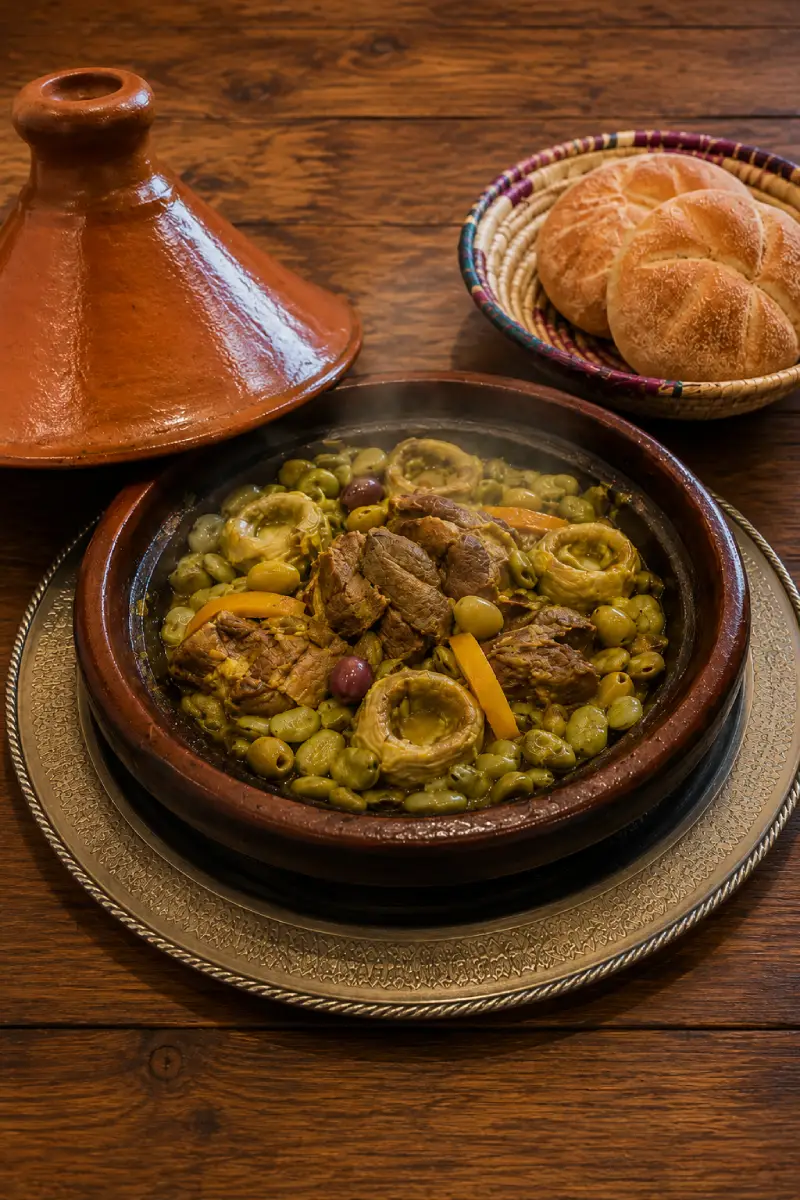
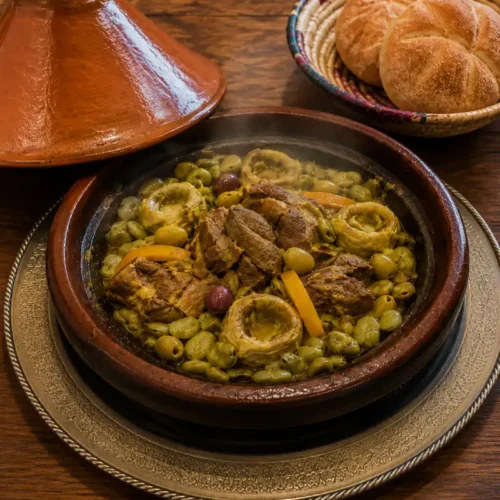
Pieces of meat were resting in a warm golden sauce. Bright fava beans filled the spaces around them. Tender artichokes sat carefully on top, still holding their shape. Nothing was swimming. Nothing looked rushed. The sauce stayed low in the pot, and the whole tagine moved with that quiet bubbling you hear only when the fire is gentle.
It was an authentic Moroccan beef tagine, but at that moment, I was not thinking about names.
I was thinking about bread.
About lunch.
About how hungry I was.
My stomach growled so loudly that my aunt laughed.
I wanted to sit down and eat immediately. I had spent the morning on the road, and the smell had already filled my head. But my aunt knew me too well. She lowered the lid, turned back toward me, and continued asking questions.
She asked about my mother again.
Then the family.
Then the road between Rabat and Fez.
Every question was chosen carefully, I think.
Just to keep my hands away from the tagine.
It was not ready.
Not yet.
The meat still needed time. The sauce still needed to settle. The artichokes and fava beans needed to take in the flavor without losing themselves.
So we waited.
When we finally sat down, the beef was tender. The fava beans were soft but still whole. The artichokes had absorbed the sauce while keeping their delicate shape. The preserved lemon gave the dish a little brightness, and the olives brought just enough salt.
We ate with bread.
Quietly at first.
That is what hunger does when the food is good. It removes the need for conversation.
Before I returned to the taxi station for the road back to Rabat, my aunt gave me a lesson I still carry into my own kitchen.
“Khalid, a good tagine needs the time it needs over a gentle fire. It needs caring hands, and above all, patience.”
— My aunt
That afternoon left me with three simple rules:
- Keep the fire gentle.
- Do not hurry the meat.
- Let patience finish what the hands begin.
This Beef Tagine Recipe with artichokes and fava beans is my way of returning to that table. It is a spring dish, a Moroccan family recipe, and a reminder that the best flavor does not always come from adding more.
Many times, it comes from waiting.
For anyone new to this kind of cooking, my guide to authentic Moroccan tagine explains how the traditional pot, the low heat, and the small amount of water work together. The page is the blog’s main tagine-cooking guide.
The road back to Rabat was waiting for me that afternoon.
But for a little while, there was only the tagine.
Why This Beef Tagine Recipe Stayed With Me
I have eaten many tagines since that day.
Some were richer. Some carried more spice. Some arrived at the table covered with almonds, prunes, or eggs. Beautiful dishes. Generous dishes. The kind people remember to photograph before anyone reaches for the bread.
But the one at my aunt’s house stayed with me for another reason.
It felt calm.
That is the word I come back to.
The meat was not fighting the fire. The vegetables were not buried beneath a heavy sauce. The spices were there, but they knew their place. Ginger. Turmeric. Pepper. Coriander. Nothing shouting over the artichokes. Nothing hiding the fresh taste of the fava beans.
And my aunt was calm too.
She did not lift the lid every two minutes. She did not push the meat around with a spoon. She did not pour in more water because the pot looked quiet.
She trusted the low fire.
She trusted the clay.
She trusted time.
That stayed with me.
What I remember most is not one single flavor. It is the whole feeling of the meal:
- the cool mountain air still sitting in my clothes;
- the smell of garlic and warm spices coming from the kitchen;
- the low bubbling beneath the clay lid;
- the bread tearing softly in the hand;
- my aunt watching the pot without disturbing it.
Years later, I read about the connection between smell and memory. A familiar scent can reach the parts of the brain connected to emotion and memory, bringing an old moment back even decades later. I did not need science to tell me that. But when I read it, I understood. One breath of ginger, garlic, and preserved lemon can still take me back to that noon in Imouzzer Kandar.
This is why this Beef Tagine Recipe matters to me.
It is not only a way to cook beef with artichokes and fava beans. It is a lesson in how a Moroccan kitchen handles good ingredients.
Slowly.
Gently.
Without trying to prove too much.
In many homes, that is where the real richness is.
Not in using the most expensive meat.
Not in filling the pot with too many spices.
Not in making the sauce heavy.
The richness comes from knowing when to turn the heat lower. From knowing when the meat needs more time. From leaving the artichokes alone once they begin to soften. From tasting the sauce before adding more salt, especially when the olives and preserved lemon are still waiting to enter the pot.
These are small decisions.
But a tagine is built from small decisions.
That is something I have seen again and again in the food of Morocco. The dishes may change from one city, season, or family to another, but care always leaves its mark. You see it in the way bread is placed close to the table. In the way vegetables are bought when they are at their best. In the way people wait until everyone is ready before the lid comes off.
My aunt’s tagine was not made for a celebration.
There were no guests waiting in the next room. No special plates. No long preparation for a feast.
It was lunch.
Just lunch.
But it was given the same attention as something important.
Maybe that is why I never forgot it.
Some meals impress you for one afternoon.
Others teach you how to cook.
What Makes This Moroccan Beef Tagine Special
This tagine is not trying to be everything at once.
There is no pile of dried fruit on top. No heavy tomato sauce. No sweetness covering the taste of the meat. The pot stays close to the season that gave it to us.
Beef.
Fresh fava beans.
Artichokes.
Olives.
Preserved lemon.
That is the heart of it.
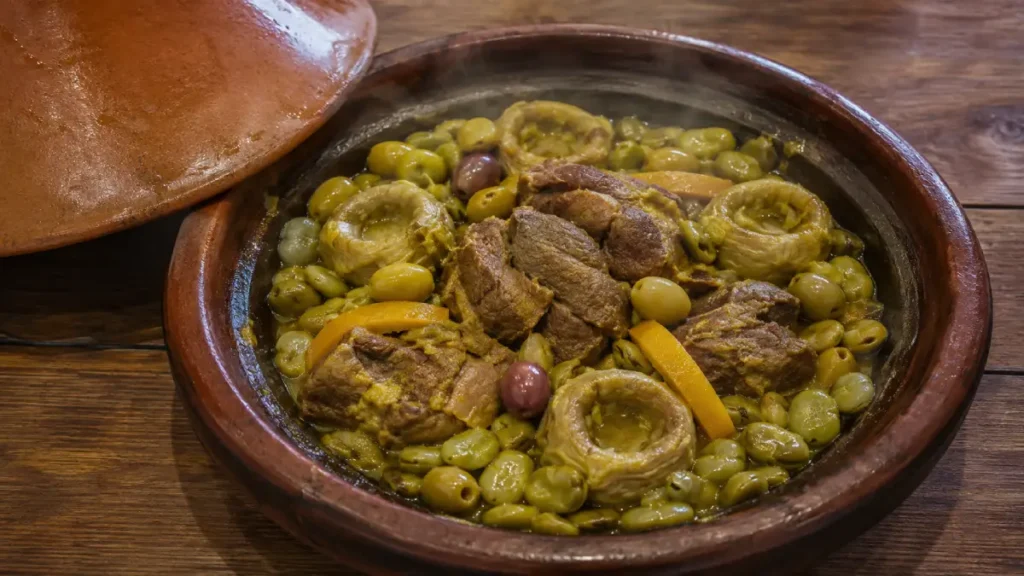
When I lift the lid, I want to recognize every ingredient. I want to see the artichokes still sitting with some dignity. I want the fava beans tender, but not crushed into the sauce. I want the beef soft enough to break with bread, after taking its time over a gentle fire.
This Beef Tagine Recipe is special because the meat and vegetables do not compete.
They help one another.
The beef gives the sauce depth. The onion melts around it. Ginger, turmeric, coriander, and black pepper warm the pot without turning it loud. Then the fava beans bring their fresh, green taste. The artichokes bring something softer. A little earthy. A little delicate. The olives and preserved lemon come later and wake everything up.
Not too much.
Just enough.
In Morocco, a dish like this belongs to spring. You see the fava beans in the market. You see the artichokes beside them. The meal almost chooses itself.
University of California gardening guidance also places artichokes and fava beans among cool-season vegetables planted for a spring harvest. That may help American readers understand why these two vegetables feel so natural together at this time of year.
But season alone is not what makes the pot good.
Balance does.
This is what I look for:
- beef that is tender, never hurried;
- artichokes that hold their shape;
- fava beans that stay whole;
- a short sauce that clings to the bread;
- spices that support the vegetables instead of hiding them;
- enough preserved lemon and olives to brighten the dish without making it too salty.
The sauce matters more than people think.
It should not run across the plate like soup. It should stay low in the tagine, glossy from the olive oil and full of the taste of the meat, onion, garlic, and vegetables.
At the end, one tablespoon of olive oil is poured over the finished dish. That small finishing touch gives the surface a soft shine and brings the aroma back up just before the bread reaches the pot.
Ah, the bread.
That is where you understand whether the sauce is right.
You tear off a piece. You press it gently against the meat and vegetables. The bread gathers the sauce without falling apart in a pool of water.
That is the texture I want.
This tagine is also different because it does not need the meat to carry every part of the meal. The vegetables have their own presence. In fact, the same spring pairing becomes a generous dish by itself in my vegetarian tagine with fava beans and artichokes.
Here, the beef adds richness.
But it does not push the vegetables into the background.
Everything keeps its face.
That is important to me.
A good Moroccan beef tagine should not taste like one heavy flavor from beginning to end. The first bite may bring the beef and warm spices. The next may bring the soft artichoke. Then comes a fava bean, a little olive, a thread of preserved lemon.
The dish changes slightly as you eat.
Quietly.
And that is what makes this Beef Tagine Recipe special.
Ingredients You Will Need
Before I begin, I like to see everything in front of me.
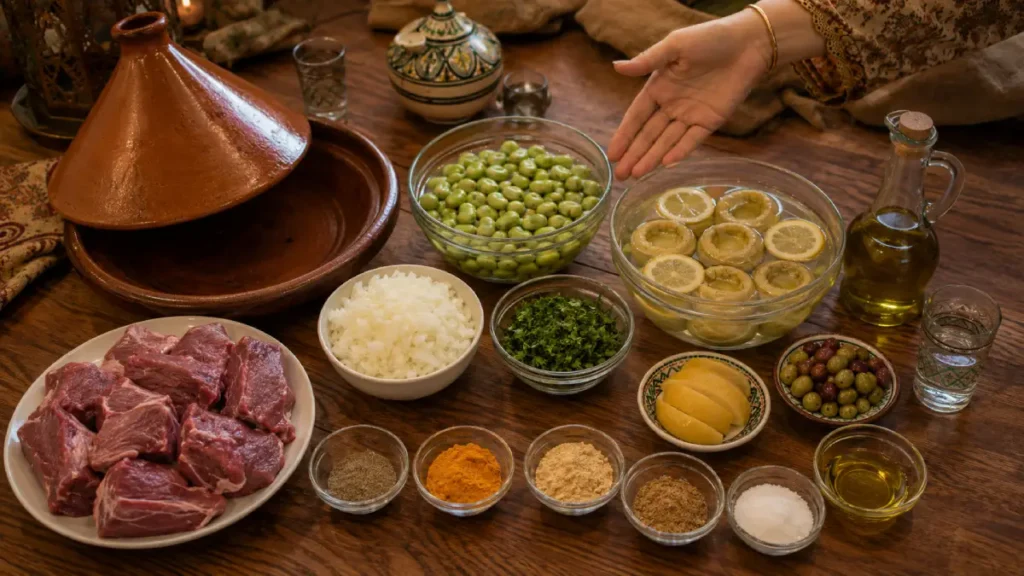
The meat. The vegetables. The little bowls of spice. The oil catching the light. The preserved lemon waiting near the olives.
It settles the hand.
It settles the mind too.
This is not a crowded dish. The ingredient list for this Beef Tagine Recipe is simple, but every ingredient has work to do. Nothing is there only for decoration. The beef gives depth. The vegetables carry the season. The spices warm the sauce. The olives and preserved lemon wake it up at the end.
“Before I light the fire, I want to see the whole meal waiting in front of me.”
— Khalid
The Beef
For this tagine, you will need:
- 500 g beef, about 1.1 pounds, cut into large pieces suitable for slow cooking.
I like the pieces generous.
Not tiny cubes that disappear between the beans. Not thin pieces that dry before the vegetables are ready. The meat needs enough size to stay tender while the tagine takes its time over the low fire.
This is not meat for fast cooking.
It needs patience.
When the pot is finished, I want each piece soft enough to separate with bread, but still large enough to hold itself in the middle of the vegetables.
The Spring Vegetables
You will need:
- 1 kg fresh fava beans, about 2.2 pounds, removed from their pods but left whole;
- 4 to 6 fresh artichokes, cleaned down to the thick, fleshy bottoms only.
These two vegetables give the dish its character.
The fava beans should look full and fresh. Not dried beans. Not tiny green peas. Fresh beans, still carrying that soft green smell of spring.
The artichokes need more attention.
For this recipe, we do not keep the complete flower heads. We remove the hard leaves, stems, and fuzzy choke until only the smooth, round artichoke bottoms remain. They should look like thick pale-green cups, with a shallow hollow in the center.
When buying whole artichokes, choose firm heads before the bracts begin to open. That is also the maturity point recommended in Utah State University’s artichoke guidance.
Once cleaned, the bottoms must be protected from the air.
But we will come to that.
One thing at a time.
The Onion, Garlic, and Parsley
You will need:
- 1 large onion, finely chopped;
- 2 garlic cloves, finely grated;
- a small handful of fresh parsley, finely chopped.
These are quiet ingredients.
The onion should not remain in large pieces. It needs to soften, melt, and become part of the sauce. Later, when you eat the tagine, you should taste what the onion gave the pot without finding a heavy pile of it under the meat.
The garlic goes in grated.
That helps it spread through the oil and spices from the beginning. It gives warmth to the sauce, but it should not sit there in large raw pieces.
And the parsley, only a little.
Enough to bring freshness.
Not enough to turn the whole tagine green.
The Moroccan Spices
You will need:
- ½ teaspoon ground black pepper;
- 1 tablespoon ground turmeric;
- 1 tablespoon ground ginger;
- ½ teaspoon ground coriander;
- salt, according to taste.
The spice bowls look small beside the vegetables, but they carry the smell of the whole kitchen.
The turmeric gives the sauce its warm golden color. The ginger brings heat, but not the sharp heat of chili. Black pepper sits underneath. Ground coriander gives a soft, earthy note that works quietly with the meat and vegetables.
I do not want the spices to hide the artichokes.
I do not want them to bury the fresh fava beans.
They should support the dish.
That is all.
The Olive Oil and Hot Water for Slow Cooking
You will need:
- 2 to 3 tablespoons olive oil for the beginning of the cooking;
- ¾ cup hot water, about 180 ml, for cooking the beef;
- up to ¼ cup additional hot water, about 60 ml, added only if needed during cooking.
At the beginning, add 2 to 3 tablespoons of olive oil to the tagine with the beef, finely chopped onion, grated garlic, finely chopped fresh parsley, spices, and salt.
Everything is mixed together before the pot is left over a gentle fire for five minutes. The oil helps the parsley, spices, onion, and garlic coat the meat evenly. It gives the ingredients a chance to meet before the water enters.
Then comes the hot water.
Three-quarters of a cup, about 180 ml.
Enough to begin the long, gentle cooking of the beef, but not enough to cover it.
Pour the hot water around the edge of the tagine and let it reach the bottom. Cover the pot and keep the heat very low. The beef should cook slowly for about 1 hour and 40 minutes, or until it is nearly tender.
Check the tagine every 25 to 30 minutes. When moisture still remains at the bottom and the bubbling is quiet, cover it again without adding anything.
When the bottom is becoming dry before the beef is nearly tender, add 2 tablespoons of hot water around the edge of the pot.
Only two tablespoons at a time.
Later, after the fava beans and artichoke bottoms enter, add a little more hot water only when the sauce is too low for the vegetables to finish cooking. Usually, no more than another ¼ cup, about 60 ml, is needed.
The ingredients need moisture.
They do not need to swim.
The Finishing Ingredients
You will need:
- a small handful of olives;
- ½ preserved lemon, cut into thick strips or wedges;
- 1 tablespoon olive oil, reserved for the finished tagine.
These ingredients do not all enter at the beginning.
The olives and preserved lemon come near the end, when the beef is tender and the vegetables are close to ready.
Taste before adding more salt.
Always.
The olives may already be salty. The preserved lemon too.
For anyone preparing it at home, I explain the full process in my mother’s preserved lemon method.
And then there is the final tablespoon of olive oil.
Keep it aside.
Do not mix it with the oil used to begin the cooking.
When the meat is tender, the vegetables are ready, and the sauce has reduced, pour that last spoonful gently over the surface of the tagine. It brings back the aroma. It gives the sauce a soft shine. It tells the dish that the fire has finished its work.
The Complete Ingredient List
- 500 g beef, about 1.1 pounds
- 1 kg fresh shelled fava beans, about 2.2 pounds, rinsed and left whole
- 4 to 6 fresh artichokes
- 1 large onion, finely chopped
- 2 garlic cloves, grated
- A small handful of parsley, finely chopped
- ½ teaspoon black pepper
- 1 tablespoon turmeric
- 1 tablespoon ground ginger
- ½ teaspoon ground coriander
- Salt to taste
- 2 to 3 tablespoons olive oil for cooking
- ¾ cup hot water, about 180 ml, for cooking the beef
- Up to ¼ cup additional hot water, about 60 ml, added only as needed
- A small handful of olives
- ½ preserved lemon
- 1 tablespoon olive oil for finishing
Look at the table once more.
The beef.
The beans.
The artichokes.
The spices waiting beside the oil.
Nothing extravagant.
But already, before the fire begins, you can see how the pot will come together.
Equipment for Making This Beef Tagine Recipe
I do not need many tools for a dish like this.
A good pot.
A small knife.
A bowl of lemon water waiting near the artichokes.
That is almost the whole kitchen.
Still, the pot matters. It changes how the heat reaches the meat, how the steam stays close to the vegetables, and how quickly the measured hot water reduces.
So choose calmly.
The Traditional Clay Tagine
For me, this dish belongs naturally in a clay tagine.
The wide base gives the beef room to sit against the onion, garlic, oil, and spices. The conical lid gathers the steam and sends it back down. You hear the cooking before you see it.
A soft bubbling.
Nothing violent.
Nothing rushing.
I like a tagine wide enough to hold the meat in one layer at the beginning, with enough space left for the fava beans and artichoke bottoms later. A pot that is too small forces everything on top of everything else. Then the vegetables break more easily, and the sauce becomes difficult to watch.
“The tagine does not ask for many tools. It asks for a quiet fire and someone willing to stay nearby.”
— Khalid
If the tagine is glazed, make sure it is made for cooking and clearly sold as food-safe cookware. Do not cook in a decorative piece simply because it looks beautiful. The FDA explains that improperly made traditional glazed pottery may release lead into food, so the vessel must be intended for food preparation, not only for display. You can read more about food-safe traditional pottery.
The Heat Diffuser
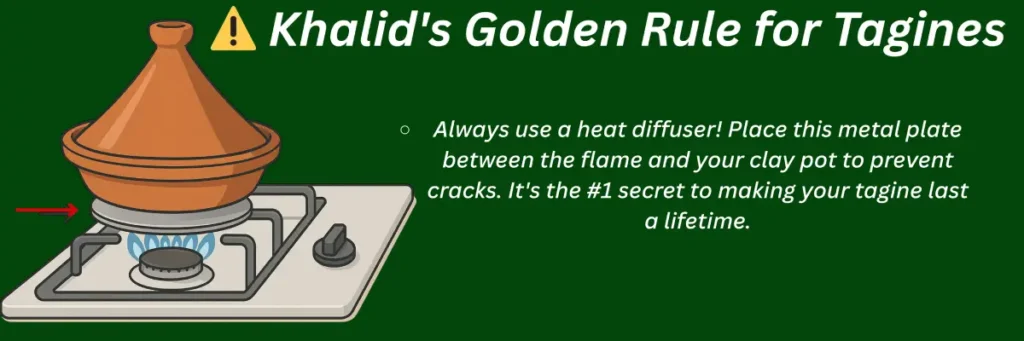
When I use clay over a stovetop, I place a heat diffuser beneath the tagine.
It creates a little distance between the flame and the clay. The heat reaches the base more gently and spreads more evenly.
This matters from the first five minutes.
Remember, we are not trying to sear the beef over an angry flame. The meat, onion, garlic, parsley, spices, and olive oil should warm together and brown only lightly.
A diffuser helps me keep that beginning calm.
Use one when:
- cooking over a gas burner;
- using an electric coil;
- working with a traditional clay tagine;
- your stovetop creates strong heat in one small area.
The fire should remain low.
Always low.
Can I Use a Dutch Oven or Regular Pot?
Yes.
A clay tagine is beautiful for this recipe, but it should never stand between you and the meal.
A Dutch oven or a heavy-bottomed pot will also work. Choose one with a tight-fitting lid and enough width to arrange the artichoke bottoms without piling them too deeply.
The method stays almost the same:
- mix the beef with the onion, garlic, parsley, spices, salt, and olive oil;
- let it cook gently for five minutes;
- add ¾ cup of hot water, about 180 ml;
- cover and cook the beef over very low heat for about 1 hour and 40 minutes, or until it is nearly tender;
- add the fava beans and artichoke bottoms only when the beef is nearly tender;
- uncover near the end only when the sauce needs to tighten.
A Dutch oven may lose moisture differently from a clay tagine. Check the bottom every 25 to 30 minutes and add hot water in 2-tablespoon amounts only when it is becoming dry.
Do not pour from fear.
That is how a short sauce becomes a soup.
The same slow approach appears throughout my slow-cooked Moroccan beef tagine, where patience matters more than the exact pot sitting over the fire.
The Small Tools That Help
Keep these close before you begin:
- a small paring knife for trimming the artichokes;
- a large transparent bowl for the lemon water;
- a medium bowl for the shelled fava beans;
- a grater for the garlic;
- a sharp knife for finely chopping the onion and parsley;
- a heatproof measuring cup or glass for measuring the hot water;
- a wooden spoon or silicone spatula for mixing the beef at the beginning;
- a thick, dry kitchen towel or heat-resistant mitt for lifting the hot clay lid safely.
After the artichokes enter, I use the spoon less.
Much less.
By then, the vegetables need peace. A gentle movement of the pot is often better than stirring through the center and breaking what has taken so much care to prepare.
This Beef Tagine Recipe does not depend on expensive equipment.
The clay is helpful.
The diffuser is helpful.
But the most important tool is still the hand that knows when to stop touching the pot.
How to Prepare the Fava Beans and Artichokes for This Beef Tagine Recipe
The meat is already under the lid by now.
It has met the onion, garlic, finely chopped parsley, spices, salt, and olive oil. It has browned gently for five minutes, and ¾ cup of hot water has gone into the tagine.
Now the beef needs time.
About 1 hour and 40 minutes over a very low fire, or until it is nearly tender.
I do not add the vegetables simply because they are ready. The meat decides when they enter.
I shell and rinse the fava beans while the beef begins its slow cooking. The artichokes need less time waiting in lemon water, so I usually clean them during the final 30 to 40 minutes of the beef’s cooking time.
The meat works beneath the lid.
The hands prepare what comes next.
Prepare the Lemon Water First
Before touching the first artichoke, fill a large transparent bowl with cold water.
Add fresh lemon juice and several thin lemon slices. Let some float on the surface and some stay beneath the water.
Do this first.
Not after cleaning the first artichoke.
Not when you notice the color beginning to change.
Before.
Once an artichoke is cut, the exposed flesh begins to darken quickly. Iowa State University Extension also recommends using lemon juice on the cut surfaces of artichokes to help prevent discoloration.
In my kitchen, the bowl must already be waiting beside the knife.
“With artichokes, the lemon water should be ready before the hand begins.”
— Khalid
That small preparation keeps the work calm.
You clean one artichoke.
You place it in the water.
Then you move to the next.
Prepare the Fresh Fava Beans
Remove the fresh fava beans from their long outer pods.
The beans inside should be full, green, and firm. Some will be larger than others. That is normal. This is a family dish, not a row of vegetables being measured for a shop window.
Place the shelled beans in a large bowl and rinse them well under cool running water.
Move them gently with your hands.
Remove any small pieces of pod, field dust, or damaged beans. Drain them, then keep them close to the stove while the meat continues cooking.
For this tagine, I leave the fresh beans whole.
I do not cut them into pieces.
I do not crush them.
I do not steam or precook them.
And I do not confuse them with small green peas. Fava beans are broader, flatter, and more substantial. When they cook, they should still be visible around the meat and artichoke bottoms.
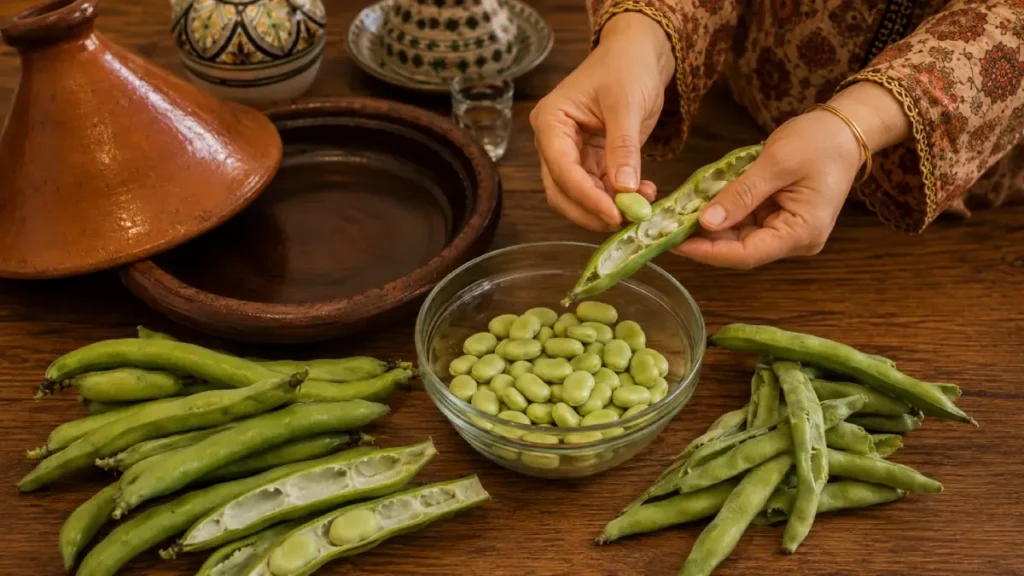
Look for beans that are:
- fresh and full;
- green rather than dry or brown;
- free from blackened or badly damaged areas;
- firm enough to remain whole during slow cooking.
Do not worry if a few beans lose their thin outer skins later in the pot.
That happens.
What matters is that most of them remain recognizable and do not disappear into the sauce.
Clean the Artichokes Down to the Bottoms
The artichokes need more patience.
For this Beef Tagine Recipe, we use only the thick, fleshy bottoms.
No outer leaves.
No stems.
No complete artichoke heads sitting in the tagine.
The finished pieces should look like round, pale-green cups with a shallow hollow in the center.
Take one artichoke at a time.
First, pull away the hard outer leaves. Keep removing them until you reach the softer, paler part beneath.
Then cut away the upper leafy section.
Trim the stem close to the base. With a small sharp knife, carefully remove the tough green skin around the outside and underside of the artichoke.
Turn it slowly in your hand.
Do not cut away too much of the flesh.
That thick bottom is what we want to keep.
Once the leaves and tough exterior are gone, remove the fuzzy choke from the center. A small spoon or the tip of a paring knife can help with this part.
Work gently.
The hollow should be clean, but the bottom must remain thick and whole.
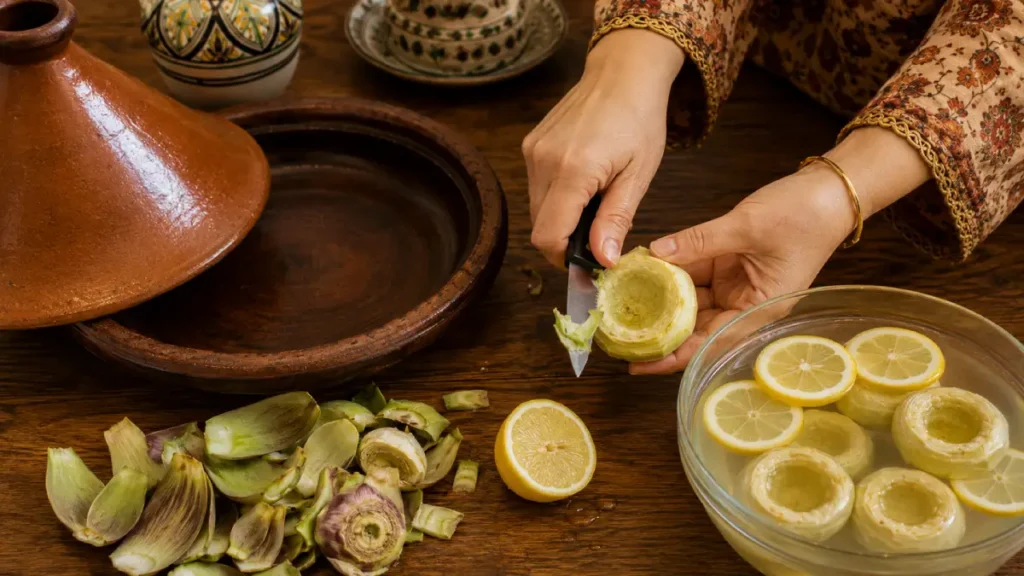
The final shape should be:
- round and compact;
- smooth around the outside;
- pale green to ivory;
- slightly hollow in the center;
- free from leaves, bracts, stem, and fuzzy choke.
The moment one bottom is cleaned, rub it with lemon and place it directly into the prepared lemon water.
Do not leave it on the cutting board while you clean the next one.
Artichokes do not wait politely.
They darken.
Keep the Artichokes Submerged
Sometimes the artichoke bottoms try to rise above the water.
Press them down gently.
A small clean plate can be placed over them when necessary, or you can turn them from time to time so every exposed surface touches the lemon water.
The lemon slices floating in the bowl are not only there to make the preparation look beautiful.
They stay close to the cut vegetables and help keep the whole bowl fresh while you finish the work.
Keep the artichokes in that water until the moment they are ready to enter the tagine.
Not longer than necessary.
Not sitting dry beside the stove.
In another spring preparation, I use the same careful approach with artichokes in my beef tagine with peas and artichokes. The vegetables may change slightly, but the need for a gentle hand does not. The related article is included in the blog’s meat-recipe collection.
Work While the Beef Cooks
By the time the beans are washed and the artichoke bottoms are resting in lemon water, the kitchen smells different.
The onion has begun to melt.
The garlic has softened.
The ginger and turmeric are rising with the steam beneath the lid.
This is why I prepare the vegetables after the meat begins cooking. The waiting time is not empty. The pot works while the hands work.
Still, stay near the stove.
Check the tagine every 25 to 30 minutes. Lift the lid briefly and look at the bottom.
When a small amount of liquid remains and the bubbling is soft, cover the pot again.
Do not add water only because the sauce looks short.
Short is what we want.
When the bottom is becoming dry before the beef is nearly tender, pour in 2 tablespoons of hot water around the edge of the tagine. Cover it again and continue cooking over the same low heat.
Do not pour the water directly over the meat.
Do not add another full glass.
After about 1 hour and 40 minutes, test one piece of beef. It should give easily and be close to tenderness before the vegetables enter.
Then:
Drain the fava beans.
Lift the artichoke bottoms from the lemon water.
Let the excess water drip away.
Bring both vegetables directly to the tagine.
Arrange them gently without pressing or stirring roughly.
The dish has now reached another stage.
The beef has completed most of its cooking.
The vegetables are ready for theirs.
How to Make This Beef Tagine Recipe
This short video gives you a quick look at the essential stages of this Beef Tagine Recipe.
But a good tagine is often decided by the small details: when to add the water, how low to keep the heat, when the beef is nearly tender, and how to protect the fava beans and artichokes from overcooking.
So after watching the video, continue with the step-by-step instructions below. Take your time, read each stage carefully, and let the pot guide you.
If one part leaves you unsure or your tagine does not look the way you expected, write to me in the comments. Tell me exactly where you feel stuck, and I will answer as soon as I can.
And when your tagine turns out beautifully, come back and leave me a kind comment. I would be very happy to hear how it went in your kitchen.
— Khalid
Now the pot begins for real.
The beef is in front of you. The onion is finely cut. The garlic is grated. The parsley is ready. The spices sit in their little bowls, and the olive oil is close to the hand.
The fava beans and artichokes can wait for a little while.
The meat goes first.
That order matters.
“Give the beef its beginning before you ask the vegetables to join it.”
— Khalid
Step 1: Mix the Beef With the Onion, Garlic, Parsley, Spices, and Olive Oil
Place the 500 g of beef in the base of the tagine.
Add the finely chopped onion, grated garlic, finely chopped fresh parsley, black pepper, turmeric, ground ginger, ground coriander, and salt. Pour in 2 to 3 tablespoons of olive oil.
Mix everything well.
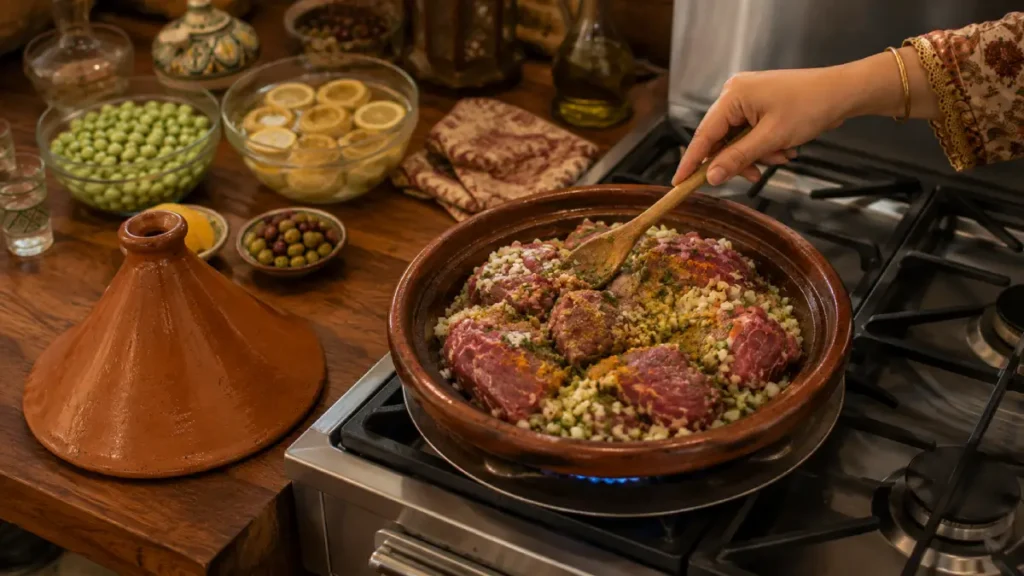
Turn the pieces of beef until the onion, garlic, parsley, spices, and olive oil coat every side.
Do not leave the turmeric in one yellow corner.
Do not leave the garlic or parsley sitting in one small pile.
Spread everything through the pot.
At this stage, the tagine still looks raw. The onion is sharp. The garlic is strong. The spices sit against the meat.
But already, the smell begins.
Step 2: Let the Beef Brown Gently for 5 Minutes
Place the tagine over low heat.
When using a clay pot on the stovetop, keep the heat diffuser underneath it. Let the base warm slowly.
Cook the beef mixture for about 5 minutes, turning the pieces gently once or twice.
This is not a hard sear.
I do not want smoke. I do not want the onion burning against the clay. I do not want a dark crust closing around the meat.
I want a gentle beginning.
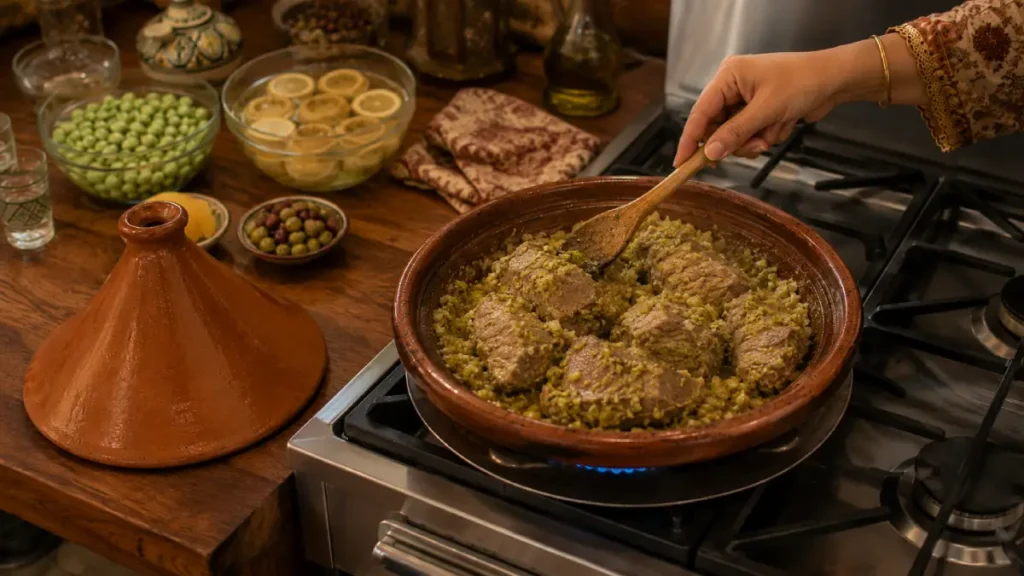
The oil warms. The onion begins to soften, while the garlic, parsley, and spices release their aroma.
The meat may take on a little color.
A little is enough.
Step 3: Add ¾ Cup of Hot Water and Cook the Beef Slowly
Pour ¾ cup of hot water, about 180 ml, gently around the edge of the tagine.
The water should be hot because the tagine base is already warm. Pour it around the side rather than directly over the pieces of beef.
Listen.
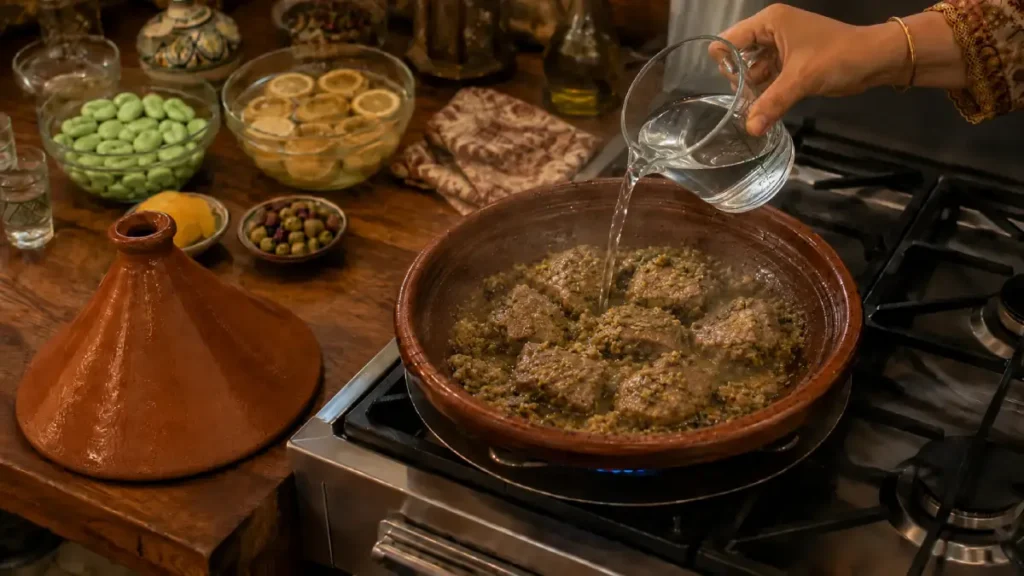
The water meets the warm base. The spices loosen. The onion begins to move into the sauce.
Use the wooden spoon to gather anything resting at the bottom, then settle the beef back into place.
Cover the tagine and keep the fire very low.
Do not add the fava beans yet.
Do not add the artichokes yet.
The beef needs time alone.
Let it cook gently for about 1 hour and 40 minutes, or until it is nearly tender. Check the bottom every 25 to 30 minutes.
When a small amount of moisture remains and the bubbling is soft, cover the tagine again without adding anything.
When the bottom is becoming dry before the beef is nearly tender, add 2 tablespoons of hot water around the edge of the pot.
Only two tablespoons at a time.
Wait before deciding whether another small addition is necessary.
Do not pour in another full glass.
Before adding the vegetables, check four things:
the onion has melted into the liquid;
the spices no longer smell raw;
the beef gives when pressed gently with a spoon or fork;
a small amount of concentrated sauce remains beneath the meat.
The clock can guide the cooking.
The meat still makes the final decision.
Step 4: Add the Fresh Fava Beans
After about 1 hour and 40 minutes, when the beef is nearly tender, drain the fresh fava beans and bring them close to the tagine.
Lift the lid carefully. The steam will carry the smell of ginger, turmeric, garlic, and meat straight toward you.
Add the beans around the beef.
Not in one heavy pile.
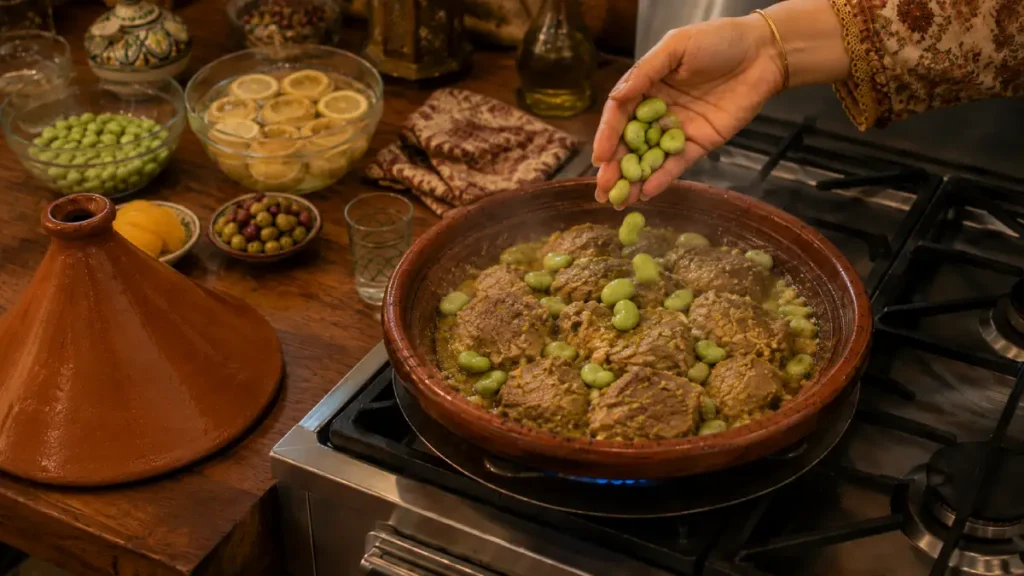
Let them fall into the spaces between the pieces of meat and around the edge of the pot. Use the spoon only when necessary to make room.
Do not stir the whole tagine from the bottom.
The sauce is already forming there.
The beans will give some moisture of their own as they cook. This is another reason not to pour in a large amount of water at the beginning.
Step 5: Arrange the Artichoke Bottoms
Lift the artichoke bottoms from the lemon water and let the excess water drip away.
Place them gently over and between the fava beans, with the shallow hollow facing upward.
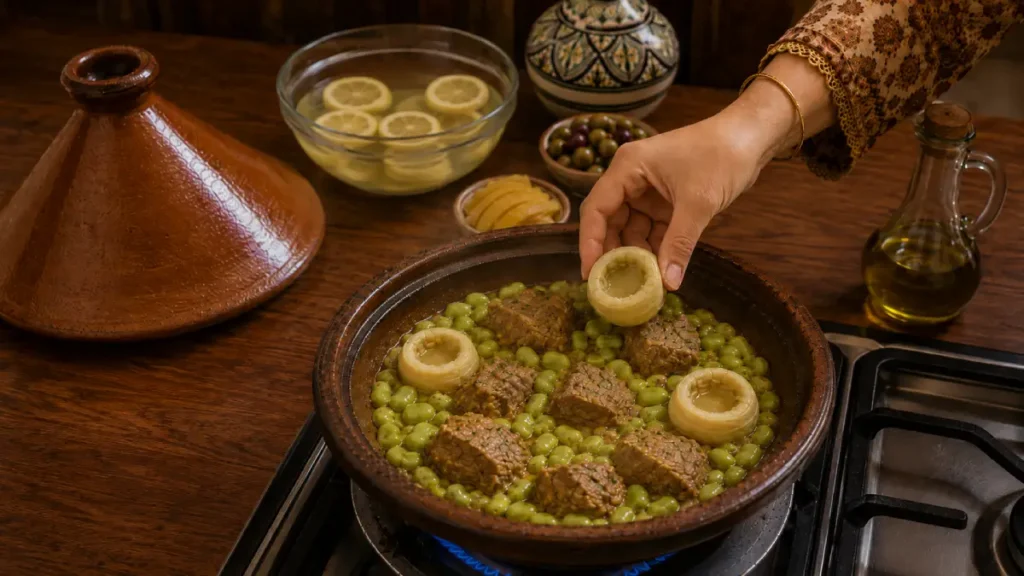
One by one.
Do not throw them into the pot.
Do not press them beneath the meat.
The artichokes should sit where you can still see them when the lid opens later. Their round shape is part of the beauty of the finished dish.
Once the artichoke bottoms are arranged, look at the sauce before adding more water.
When enough moisture remains beneath the beef and beans, cover the tagine without adding anything.
When the bottom looks too dry for another 20 to 30 minutes of cooking, pour in 2 tablespoons of hot water around the edge of the tagine.
Do not pour it directly over the artichokes.
Let the water slip beneath the meat and vegetables.
Add another 2 tablespoons later only when the pot truly needs it. During this stage, up to ¼ cup of additional hot water may be used, but it should never be added automatically.
Then cover the tagine again.
Nothing more.
“Once the artichokes enter, let the fire do more work than the spoon.”
— Khalid
Step 6: Let the Meat and Vegetables Cook Together
Keep the tagine covered over a gentle fire for 20 to 30 minutes.
Begin checking the vegetables after 20 minutes.
The bubbling should remain soft and steady. You should hear the cooking, but it should never sound angry.
Now the flavors begin to join.
The beef gives depth to the sauce. The fava beans soften around it. The artichoke bottoms absorb the onion, garlic, turmeric, ginger, and meat juices.
Stay nearby.
From time to time, lift the lid and look at the level of the sauce. There should be enough moisture for the ingredients to cook, but the vegetables should not float.
This dish should never become a soup.
Check the beef with the edge of a spoon or a fork. Check one fava bean. Touch the thickest part of an artichoke bottom.
You are looking for:
- beef that gives easily;
- fava beans that are tender but still visible;
- artichoke bottoms that are soft without collapsing;
- a sauce that stays close to the ingredients.
When the beef is still firm, cover the pot and give it more time.
Patience is still part of the recipe.
Step 7: Add the Olives and Preserved Lemon
When the beef is tender and the vegetables are close to ready, add the olives and half of the preserved lemon, cut into thick strips or wedges.
Place them naturally between the meat and vegetables.
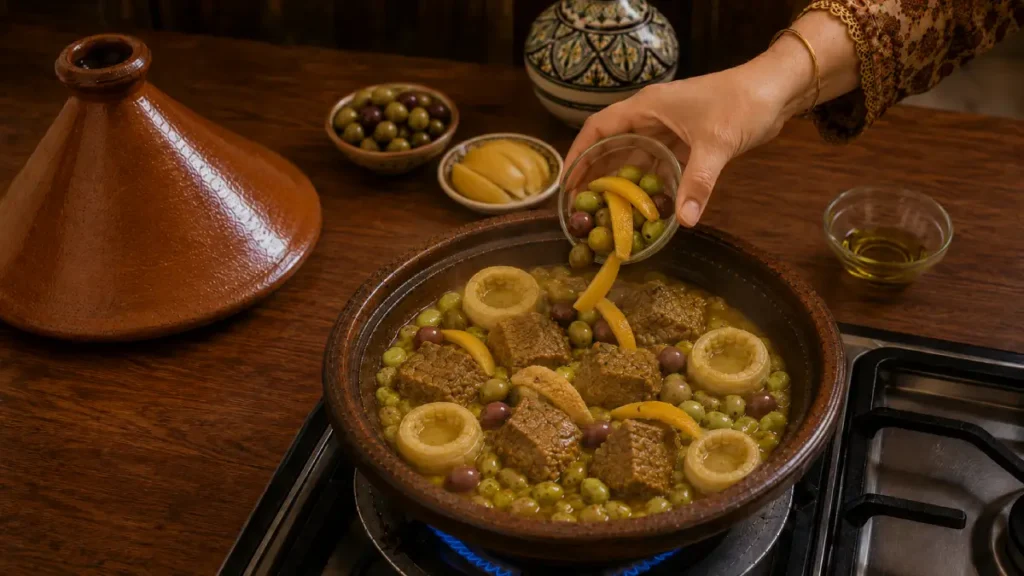
The olives bring salt.
The preserved lemon brings brightness.
This is why I taste the sauce before adding any more salt. A pot that tasted balanced ten minutes earlier can become too salty after these final ingredients enter.
Let everything cook together gently until the olives are warm and the preserved lemon has given its aroma to the sauce.
For another version built around that sharp, fragrant finish, you can see my Moroccan beef tagine with preserved lemons and olives.
Step 8: Reduce the Sauce and Finish With Olive Oil
Toward the end, open the tagine and look properly.
The sauce should be short.
Not dry.
Not watery.
Short.
It should sit beneath and around the beef and vegetables, glossy and concentrated, with the onion almost disappeared into it.
When the sauce is still loose, leave the lid slightly open and let it reduce gently. Do not suddenly turn the fire high. A strong flame can damage the bottom of the sauce while the top still looks unfinished.
When the beef is tender, the fava beans are cooked, the artichoke bottoms remain whole, and the sauce has reached its point, turn off the heat.
Now take the final tablespoon of olive oil that you kept aside.
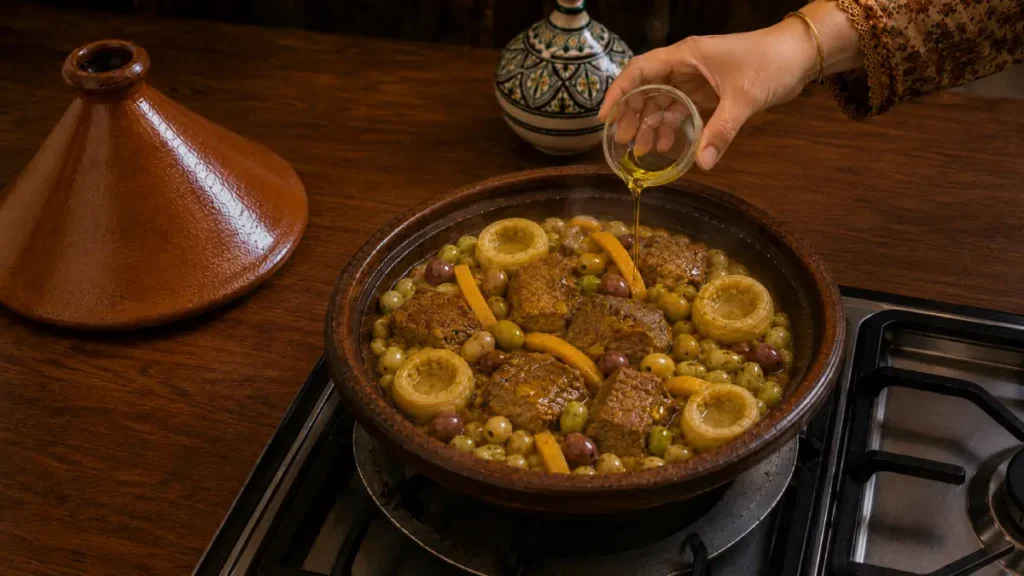
Pour it slowly over the surface of the tagine.
Across the beef.
Across the fava beans.
Across the artichokes.
That last spoonful is not there to cook. It is there to finish. It brings a fresh olive-oil aroma back to the pot and gives the surface a quiet shine before the tagine reaches the table.
Then stop.
Do not keep cooking because the clay is still warm.
Do not keep adjusting because you are afraid to finish.
This Beef Tagine Recipe is ready when the meat gives, the vegetables hold themselves, and the sauce stays close to the bread.
Bring the loaf to the table.
The tagine is ready.
Common Mistakes to Avoid
A tagine can forgive small things.
One onion cut a little larger than the others. A few fava beans losing their skins. An artichoke bottom that does not sit perfectly upright.
But some mistakes change the whole pot.
They make the beef fight the bread. They turn the sauce into water. They take vegetables that should still have a face and reduce them to something you can no longer recognize.
This Beef Tagine Recipe needs very little force.
Low fire.
A small amount of water.
And the patience to leave the pot alone when the ingredients are doing well without you.
Cooking the Beef Too Quickly
When people ask me, “Why is my beef tagine tough?” I usually think first about the fire.
A strong flame may make the outside of the meat look cooked very quickly, but that does not mean the inside has had time to soften.
Beef for a tagine needs slow, moist cooking. The USDA guidance on beef cuts and cooking methods also explains that less-tender cuts such as chuck and round benefit from moist heat, including braising.
After five minutes, ¾ cup of hot water, about 180 ml, goes in.
Then the lid closes, and the beef cooks slowly for about 1 hour and 40 minutes, or until it is nearly tender.
Do not turn up the heat because the meat still feels firm.
Firm meat is not asking for a hotter flame.
It is asking for more time.
“When the beef resists the spoon, I do not fight it. I cover the pot again.”
— Khalid
Keep the bubbling quiet. Check the meat from time to time with the edge of a spoon or a fork.
When it gives easily, without needing force, it is moving toward tenderness.
Adding Too Much Water
Begin with ¾ cup of hot water, about 180 ml.
That is the measured starting point for the beef.
Pour it around the edge of the tagine after the meat has cooked gently for five minutes. The water should reach the bottom without covering the pieces of beef.
Then cover the pot and keep the heat very low.
Check the tagine every 25 to 30 minutes.
When a small amount of moisture remains and the bubbling is soft, do not add anything.
When the bottom is becoming dry before the beef is nearly tender, add 2 tablespoons of hot water around the edge of the tagine.
Only two tablespoons at a time.
Wait before deciding whether another small addition is necessary.
After the fava beans and artichoke bottoms enter, follow the same rule. Add another 2 tablespoons only when there is not enough moisture for the vegetables to finish cooking.
During this final stage, up to ¼ cup of additional hot water may be needed, but it should never be poured in automatically.
Too much water weakens everything.
The spices spread too far. The meat juices lose their depth. The fava beans and artichokes begin to float instead of cooking in a short Moroccan sauce.
The ingredients need moisture.
They do not need to swim.
Adding the Vegetables Too Early
The beef and the vegetables do not need the same amount of time.
That is why the meat goes first.
Fresh fava beans can soften quickly once they enter the covered tagine. Artichoke bottoms also become delicate after absorbing the hot sauce. When both are added before the beef is nearly tender, they must remain in the pot for too long.
The result is easy to see.
The beans collapse.
The artichokes lose their round shape.
And the beef may still be firm underneath them.
Wait until the onion has melted into the sauce, the spices no longer smell raw, and the beef is nearly tender.
In this recipe, that usually takes about 1 hour and 40 minutes over a very low fire.
Only then should the fresh fava beans and artichoke bottoms enter the tagine.
The same patient order matters in my Moroccan beef and green beans tagine, even though the vegetable and preparation are different.
The vegetables are not late.
They are entering at the time that protects them.
Stirring After the Artichokes Soften
Before the artichokes enter, a wooden spoon is useful.
After they soften, it can become the enemy.
This is the answer I give when someone asks how to keep artichokes whole: arrange them carefully, with the shallow hollows facing upward, and then stop moving through the center of the tagine.
Do not dig beneath them with the spoon.
Do not turn them over.
Do not stir the beans from the bottom once everything has become tender.
When the surface needs moisture, collect a little sauce carefully from the edge and spoon it over the artichoke bottoms without touching or pressing their sides.
Then leave them alone.
A softened artichoke can break with one careless movement.
The taste will still be there.
But the beautiful round bottom that you cleaned so patiently will be gone.
Adding Too Much Salt Before the Olives
Salt does not finish its work when the meat begins cooking.
The olives still have something to say.
The preserved lemon too.
Both can bring considerable salt to the sauce near the end. If the pot is already fully salted before they enter, there is very little room left to correct it.
Season the beef carefully at the beginning.
Not heavily.
Then, after adding the olives and preserved lemon, let them warm in the sauce and taste again. Only then should you decide whether the tagine needs more salt.
This is especially important when using store-bought preserved lemons or olives kept in a strong brine. Their saltiness can change from one jar to another.
A sauce can accept another pinch.
It cannot easily give one back.
Serving Before the Sauce Has Reduced
When the meat and vegetables are tender, the tagine may look finished.
But look at the bottom.
The sauce must finish too.
If you have asked, “Why is my tagine watery?” the answer may simply be that it left the fire too early. The meat may be soft and the artichokes may be ready, but the cooking liquid has not yet concentrated around them.
Remove the lid, or leave it slightly open, and allow the sauce to reduce over the same gentle heat.
Do not make the flame angry at the last moment.
People searching for how to thicken tagine sauce sometimes expect flour, cornstarch, or another thickener.
This dish needs none of them.
In a good Beef Tagine Recipe, the sauce thickens through gentle reduction as the onion melts and the cooking liquid becomes more concentrated.
The finished sauce should be short and glossy.
It should remain beneath and around the beef and vegetables rather than covering them. When a piece of khobz touches the bottom, the sauce should cling to it.
Not run away from it.
That is when the tagine is ready to leave the fire.
Not before.
What to Serve With Moroccan Beef Tagine
When this tagine reaches the table, it does not need many companions.
The meat is already rich. The fava beans and artichokes bring the vegetables. The olives and preserved lemon wake the sauce. Adding too many dishes around it can make the meal feel heavier than it needs to be.
For me, the table needs four things.
Warm bread.
A light salad.
Perhaps one or two simple vegetable plates.
And enough time for everyone to eat from the same tagine.
Moroccan Bread or Khobz
When someone asks me what to serve with beef tagine, I begin with bread.
Always bread.
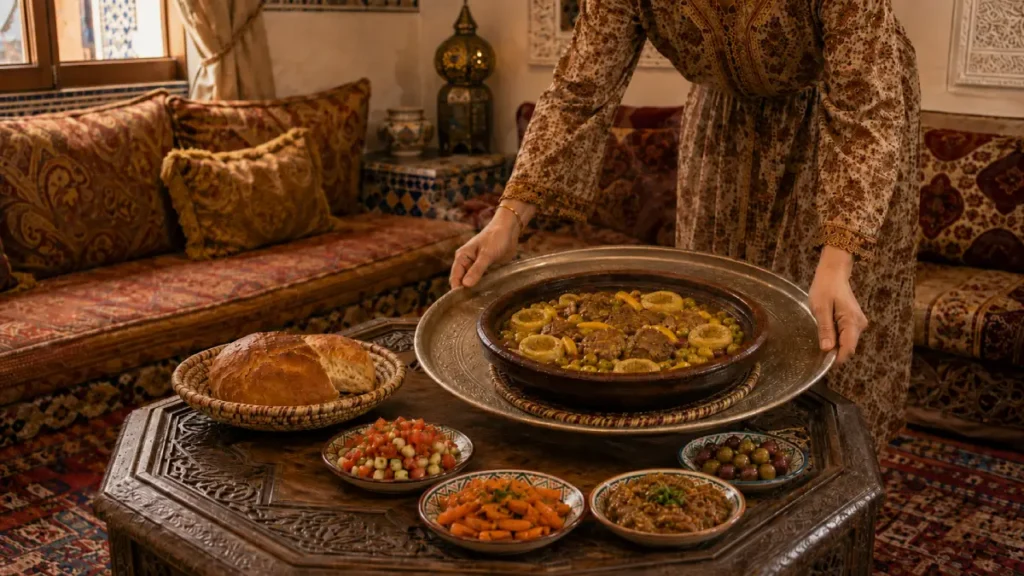
In the meal I remember at my aunt’s house, there were no individual plates waiting beside the tagine. She placed the pot in the middle of the table and brought a basket of khobz.
We tore the bread with our hands.
Then each person used a small piece to take some beef, a few fava beans, part of an artichoke bottom, and a little sauce directly from the tagine.
That is how the meal came together.
The bread was not sitting beside the dish only to fill the stomach. It had work to do. It held the tender meat. It gathered the vegetables. It reached the short golden sauce that remained beneath them.
A fork can lift the beef.
But bread carries the whole bite.
“At a Moroccan family table, the bread is already the spoon in your hand.”
— Khalid
Choose a round Moroccan bread with enough structure to hold the sauce without falling apart immediately. The crust should be firm, while the inside remains soft enough to press gently around the meat and vegetables.
For readers who would like to make it at home, my Moroccan bread recipe explains how I prepare the khobz that belongs beside a pot like this.
Do not cut it into neat restaurant slices.
Tear it.
Pass it around.
Let the basket move from one hand to another.
That small movement is part of the family-style meal.
Keep the Moroccan Salad Light
A Moroccan salad beside this tagine should bring freshness, not another heavy sauce.
A simple chopped tomato and cucumber salad works well. The cool vegetables give the mouth a small break between bites of beef and concentrated tagine sauce.
Keep it modest.
Tomatoes.
Cucumber.
A little onion when you like it.
Fresh parsley or cilantro.
Salt.
Perhaps a small amount of olive oil and lemon juice.
That is enough.
The salad does not need mayonnaise, cheese, or a thick dressing. It should remain bright and clean beside the warm spices of the tagine.
Serve it in one or two small plates for the table rather than giving every person a large bowl. People can take a little between bites, then return to the bread and the tagine.
At my aunt’s table, the salad never tried to become the meal.
It simply helped the meal breathe.
Add Simple Raw or Cooked Vegetables
You may also place a few raw vegetables on the table.
Cucumber sticks, tomato wedges, radishes, or tender lettuce leaves can bring crunch and freshness. This is especially useful when the tagine sauce is rich and the preserved lemon has a strong flavor.
Cooked Moroccan vegetable salads also work well, but choose only one or two.
Carrot salad brings gentle sweetness and a little spice.
Zaalouk brings soft eggplant and tomato.
A small plate of cooked peppers can add freshness without overwhelming the main dish.
The portions should remain small.
This Beef Tagine Recipe already contains a generous quantity of fava beans and artichokes. The side dishes are not there because the meal lacks vegetables. They are there to offer another temperature, another texture, and a little contrast.
Do not crowd the table until the tagine becomes difficult to reach.
Leave the center open.
The bread should move easily.
The hands should reach the food without passing over six large dishes.
A family table can be generous without becoming complicated.
Does Beef Tagine Have to Be Served With Couscous?
No.
Couscous is an important Moroccan dish, but it is not an obligatory side for every tagine.
In the family setting behind this recipe, we ate the beef, artichokes, fava beans, and sauce with khobz directly from the tagine.
No couscous was needed.
You may serve couscous when that is what your family enjoys, but it should not be presented as the only traditional way to complete this particular meal.
For this sauce, I prefer bread.
The sauce is short and concentrated. A piece of khobz can press against the bottom of the tagine and collect it properly.
Nothing is left behind.
Finish the Meal With Moroccan Mint Tea
After the tagine, clear the main plates slowly.
There is no need to hurry everyone away from the table.
Bring out the teapot.
Fresh mint.
Small glasses.
The University of Illinois’ Salaam Middle East and North Africa Cultural Center describes the drink as regionally shared but famously known as Moroccan mint tea. It belongs naturally to moments of welcome, conversation, and sitting together after the food has finished.
The tea does not need to arrive while everyone is still reaching into the tagine.
Let the meal finish first.
Let the bread basket become quiet.
Then pour the tea and allow the conversation to continue.
That is often the final part of a Moroccan family meal.
Not another course.
A pause.
A warm glass held between the fingers.
The smell of mint rising after the smell of ginger, turmeric, beef, and preserved lemon.
At my aunt’s house, the road back to Rabat was still waiting for me.
But the tea made me sit a little longer.
Frequently Asked Questions
Some questions come only after the lid has been lifted a few times.
The beef is still firm.
The sauce looks lower than expected.
The artichokes are waiting in lemon water, and the cook begins to wonder whether everything is happening at the right moment.
These are the questions I hear most often about this Beef Tagine Recipe.
What Cut of Beef Is Best for Beef Tagine?
Choose a cut that becomes tender through slow, moist cooking.
Beef chuck is a very good choice. Stew meat cut from the shoulder also works well. Pieces with a little connective tissue and some fat usually give the sauce more depth and soften better than very lean cuts meant for quick cooking.
Ask for large pieces rather than tiny cubes.
Small pieces can dry out or disappear between the fava beans. I want the beef to remain visible when the tagine reaches the table, but tender enough to separate with bread.
This pot does not cook in a hurry.
Can I Make This Recipe Without a Tagine Pot?
Yes.
Use a Dutch oven or a wide, heavy-bottomed pot with a tight-fitting lid. Choose one with enough room to arrange the artichoke bottoms without stacking them too deeply.
The method remains the same:
begin with the beef, onion, garlic, parsley, spices, salt, and olive oil;
brown everything very gently;
add ¾ cup of hot water, about 180 ml;
cover and cook the beef gently until it is nearly tender;
add the fava beans and artichokes later;
reduce the sauce near the end.
A Dutch oven may lose moisture differently from a clay tagine. Check the bottom every 25 to 30 minutes and add hot water in 2-tablespoon amounts only when it is becoming dry.
The pot may change.
The need for low heat does not.
How Long Does the Beef Take to Become Tender?
In a clay tagine over a very low fire, allow about 1 hour and 40 minutes after adding the hot water.
The exact time can still vary with the cut of beef, the size of the pieces, the width of the tagine, and the strength of the flame.
Begin checking the meat before the full time has passed. Press one piece gently with the edge of a spoon or pierce it with a fork.
The beef should be nearly tender before the fava beans and artichoke bottoms enter. The vegetables then need another 20 to 30 minutes.
The clock gives you a direction.
Tenderness gives you the answer.
Why Is My Beef Tagine Still Tough?
Usually, it needs more time.
A strong flame does not make slow-cooking beef tender faster. It may reduce the liquid too quickly while the inside of the meat remains firm.
Lower the heat.
Check that a small amount of moisture still remains beneath the beef.
If the bottom is nearly dry, add 2 tablespoons of hot water around the edge of the tagine. Cover it again and continue cooking over low heat.
Do not pour in another full glass.
Do not increase the flame.
“Tough beef does not ask me for anger. It asks me to close the lid again.”
— Khalid
How Much Water Should I Add to the Tagine?
Begin with ¾ cup of hot water, about 180 ml, after the beef has cooked gently for five minutes.
Cover the tagine and let the beef cook over very low heat for about 1 hour and 40 minutes. Check the liquid every 25 to 30 minutes.
When a small amount of moisture still remains at the bottom, do not add anything.
When the bottom is nearly dry before the beef is tender, add 2 tablespoons of hot water around the edge of the pot.
After adding the fava beans and artichoke bottoms, add more hot water only when the sauce is too low for the vegetables to finish cooking. Use 2 tablespoons at a time, up to about ¼ cup during this stage when necessary.
The exact final amount may change slightly from one tagine to another.
The starting measurement does not change:
¾ cup of hot water.
The later additions depend on what you see in the pot.
Can I Use Frozen Fava Beans?
Yes, when fresh fava beans are unavailable.
Frozen fava beans are usually softer than freshly shelled beans and may cook more quickly. Add them at the same stage as fresh fava beans, when the beef is nearly tender, but begin checking them sooner.
Keep the heat gentle and avoid stirring them repeatedly. There is no need to steam or precook them for this Beef Tagine Recipe.
Add them directly to the tagine and let them finish cooking gently in the sauce.
Can I Use Frozen Artichoke Bottoms?
Yes.
Choose plain frozen artichoke bottoms without seasoning or sauce. Let them thaw only enough to separate, then drain away the excess water before placing them in the tagine.
Because frozen artichoke bottoms may soften faster than freshly cleaned ones, add them only when the beef is nearly tender.
Place them with the hollows facing upward.
Once they become tender, stop stirring through the center of the pot.
Their shape depends on a gentle hand.
When Should I Add the Olives and Preserved Lemon?
Add them near the end, after the beef is tender and the fava beans and artichoke bottoms are close to ready.
Olives and preserved lemon do not need the full cooking time. They need only enough time to warm through and share their flavor with the sauce.
Taste before adding more salt.
The olives may be briny.
The preserved lemon may be salty too.
A small amount can brighten the entire pot. Too much can hide the fresh taste of the vegetables.
How Do I Stop the Artichokes From Browning?
Prepare the lemon water before you begin cleaning them.
Fill a bowl with cold water, fresh lemon juice, and a few lemon slices. As soon as one artichoke bottom is trimmed and the fuzzy choke is removed, rub the cut surface with lemon and place it directly into the bowl.
Keep the bottoms submerged until they are ready to enter the tagine.
Do not clean all the artichokes first and look for a bowl afterward.
By then, the color may already be changing.
Is Beef Tagine Served With Bread or Couscous?
For this family recipe, serve it with Moroccan bread, or khobz.
Place the tagine in the center of the table. Tear the bread into manageable pieces and use it to take the beef, fava beans, artichokes, and short sauce directly from the pot.
Couscous is an important Moroccan dish, but it is not an obligatory accompaniment to every tagine.
Here, bread makes more sense to me.
It gathers the sauce.
It holds the meat.
And it keeps the meal close to the way I remember eating it at my aunt’s table.
Can I Make Beef Tagine One Day Ahead?
Yes.
The sauce may taste even more settled the next day.
Allow the food to cool briefly, then transfer it to shallow containers and refrigerate it promptly rather than leaving it for hours inside the warm clay pot.
Reheat it slowly over gentle heat.
Add only a spoonful of water when the sauce has tightened too much. Move the beef carefully and avoid stirring through the softened artichoke bottoms.
Warm everything thoroughly.
Then bring the bread back to the table.
Hands close.
And no hurry.
From My Aunt’s Kitchen to Yours
When I think about this tagine, I still return to that afternoon in Imouzzer Kandar. I remember the road from Rabat, the taxi station, and the cool air outside my aunt’s house.
Then came the smell waiting behind her door. Garlic, ginger, and meat cooking slowly beneath the clay lid.
I remember lifting that lid too early because hunger had made me impatient. The steam reached my face, and my aunt laughed before covering the pot again.
The tagine still needed time.
So did I.
That may be the most important part of this Beef Tagine Recipe. It is not the exact position of every artichoke bottom, whether every fava bean keeps its skin, or whether your bread looks perfectly round.
What matters is the way you treat the pot.
Keep the fire gentle and give the beef enough time to soften. Let the vegetables cook without disturbing them too much, then allow the sauce to reduce until it stays close to the meat, the fava beans, and the artichokes.
Then stop.
Bring the tagine to the table while it is still warm, and place the khobz nearby. Let everyone tear the bread with their hands and reach toward the same dish.
One person finds a piece of beef. Another takes an artichoke bottom. Someone presses the bread into the sauce left beneath the fava beans.
That is how a tagine becomes more than food. It becomes the center of the table.
“The hands begin the meal, but patience is what brings it home.”
— Khalid
My aunt did not explain cooking with long lessons. She showed me through the flame, the small amount of water, and the way she moved the vegetables only when they truly needed her.
She also showed me through the way she kept me talking until the tagine had finished cooking.
Years later, those quiet gestures still return whenever I place a clay pot over the fire. I hope they enter your kitchen too.
Perhaps your tagine will not look exactly like hers, and it does not need to. Your beef may be cut a little differently, your artichokes may sit in another arrangement, and a few fava beans may open in the sauce.
That is all right.
Keep the ingredients recognizable, keep the sauce short, and keep the bread close. Above all, give the pot the time it asks for.
When I finally left my aunt’s house that day, the road back to Rabat was still long. But I carried the smell of the tagine with me.
The preserved lemon, the warm spices, and the olive oil shining over the finished dish all stayed in my mind.
So did the lesson she had given me before I returned to the taxi station.
A gentle fire.
Caring hands.
And patience.
From my aunt’s kitchen to yours, I hope this tagine brings everyone a little closer to the table.
Authentic Beef Tagine Recipe with Artichokes and Fava Beans
Equipment
- 1 Traditional clay tagine with lid
- 1 Heat diffuser
- 1 Small paring knife
- 1 Sharp kitchen knife
- 1 Cutting board
- 1 Large bowl for lemon water
- 1 Medium bowl for the shelled fava beans
- 1 Fine grater
- 1 Wooden Spoon or Silicone Spatula
- 1 Heatproof measuring cup or glass For measuring the initial hot water and any small additions during cooking.
- 1 Thick, dry kitchen towel or heat-resistant mitt
- 1 Dutch oven or wide heavy-bottomed pot Optional alternative to a clay tagine
Ingredients
Beef, Aromatics, and Spices
- 500 g beef About 1.1 lb cut into large pieces suitable for slow cooking
- 1 large onion Finely chopped
- 2 cloves garlic Finely grated
- A small handful fresh parsley finely chopped
- 1/2 teaspoon ground black pepper
- 1 tablespoon ground turmeric
- 1 tablespoon ground ginger
- 1/2 teaspoon ground coriander
- salt To taste; season carefully before adding the olives and preserved lemon
- 2 –3 tablespoons olive oil For the beginning of cooking
- 3/4 cup hot water About 180 ml, added after gently browning the beef
Fresh Spring Vegetables
- 1 kg fresh fava beans About 2.2 lb after shelling; rinse well and leave the beans whole.
- 4 –6 fresh artichokes Cleaned down to the thick fleshy bottoms only
- cold water For holding the cleaned artichoke bottoms
- 1 fresh lemon Juice and slices for the lemon water
- up to 1/4 cup additional hot water About 60 ml; add only as needed, 2 tablespoons at a time
For Finishing
- 1/2 preserved lemon Cut into thick strips or wedges
- 1/2 cup olives Rinsed if very salty
- 1 tablespoon olive oil Reserved for finishing the cooked tagine
Instructions
Start the Beef
- Place the beef in the base of the tagine. Add the finely chopped onion, grated garlic, chopped parsley, black pepper, turmeric, ground ginger, ground coriander, salt, and 2 to 3 tablespoons of olive oil. Mix well until every piece of beef is evenly coated with the onion, herbs, spices, and oil.
- Place the tagine over a heat diffuser and set it over low heat. Cook the mixture gently over low heat for 5 minutes, turning the beef once or twice. The onion should begin to soften, while the garlic, parsley, and spices release their aroma. Do not use high heat or attempt a hard sear.
- Pour ¾ cup of hot water, about 180 ml, around the edge of the tagine. Gently loosen anything resting on the bottom, settle the beef back into place, and cover. Cook over very low heat for about 1 hour and 40 minutes, or until the beef is nearly tender. Check every 25 to 30 minutes and add 2 tablespoons of hot water only if the bottom is becoming dry.
Prepare the Vegetables
- While the beef begins its slow cooking, remove the fresh fava beans from their pods. Rinse them well under cool running water, drain them, and leave them whole. Do not cut, steam, or precook the beans.
- Fill a large bowl with cold water, fresh lemon juice, and several lemon slices. Remove the hard leaves and stems from each artichoke, trim away the tough green exterior, and remove the fuzzy choke until only a thick, smooth artichoke bottom remains. Rub each cleaned bottom with lemon and place it immediately in the lemon water.
Add the Spring Vegetables
- When the beef is nearly tender after about 1 hour and 40 minutes, drain the fresh fava beans. Add them around and between the pieces of beef without stirring the entire tagine from the bottom.
- Drain the artichoke bottoms and arrange them over and between the fava beans with their shallow hollows facing upward. Check the sauce before adding more water. If the bottom looks too dry for the vegetables to cook, add 2 tablespoons of hot water around the edge. Add more later only when necessary, up to about ¼ cup in total.
- Cover the tagine and cook the vegetables gently for 20 to 30 minutes. Begin checking them after 20 minutes. The beef should become tender, the fava beans should remain visible, and the artichoke bottoms should soften without collapsing.
Finish the Tagine
- When the beef is tender and the vegetables are close to ready, add the olives and preserved lemon strips.
- When all the ingredients are tender, leave the lid slightly open if necessary and allow the sauce to reduce gently. Do not increase the heat sharply. The finished sauce should be short, glossy, and concentrated, with no deep broth and no vegetables floating in liquid.
- Turn off the heat. Pour the reserved tablespoon of olive oil gently over the beef, fava beans, and artichoke bottoms. Allow the tagine to settle briefly, then serve it warm with Moroccan bread.
Notes
🥣 Nutrition Information (Per Serving)
| Nutrient | Amount |
|---|---|
| Calories | 550 kcal |
| Cholesterol | 90 mg |
| Potassium | 1,100 mg |
| Sugar | 11 g |
| Saturated Fat | 10 g |
| Protein | 35 g |
| Carbohydrates | 32 g |
| Fat | 34 g |
| Fiber | 11 g |
| Sodium | 780 mg |
📌 Note: Nutrition information is an estimate per serving and does not include Moroccan bread, salads, or mint tea. Values may vary depending on the cut of beef and the salt content of the olives and preserved lemon.
Join Me at the Moroccan Table
Some recipes begin with ingredients. Others begin with a road, a family memory, or the smell rising from a clay tagine.
Subscribe, and I will send you the Moroccan recipes I cook at home, the small techniques passed through my family, and the stories that make each dish worth remembering.
No noise and no rushed recipes. Only good food, caring hands, and a little more Morocco in your kitchen.
Fresh Moroccan recipes and kitchen stories, sent with care. Unsubscribe anytime.
Follow the Journey Beyond the Tagine
Some recipes stay on the page. Others continue through the markets, the family table, and the small moments that happen before the lid is lifted.
Follow me for new Moroccan recipes, behind-the-scenes cooking, seasonal ingredients, quick tagine tips, and stories from my kitchen.
Choose the place you enjoy most, or follow me on all four so you never miss the next recipe.
A little more Morocco, wherever you like to follow.
Share Your Place at the Table
Every kitchen changes a recipe a little. Maybe your beef needed more time, your artichokes came from a frozen bag, or the smell of the tagine reminded you of someone in your own family.
Did you make this Beef Tagine Recipe? Tell me what worked, what you changed, or where you would like a little help. Leave your question, your experience, or the small story that came to you while the tagine was cooking.
I read every comment, and I will be happy to meet you there.
What happened when this tagine reached your table?